

Note: This post is not paywalled. Enjoy!
Lately I’ve had a bunch of small-ish items that I’ve wanted to write about — things that don’t merit a full article but deserve more than the one-sentence treatment they’d get in the Inconspicuous News Roundup. So today I’m going to address a bunch of those items, along with a couple of follow-ups to recent posts.
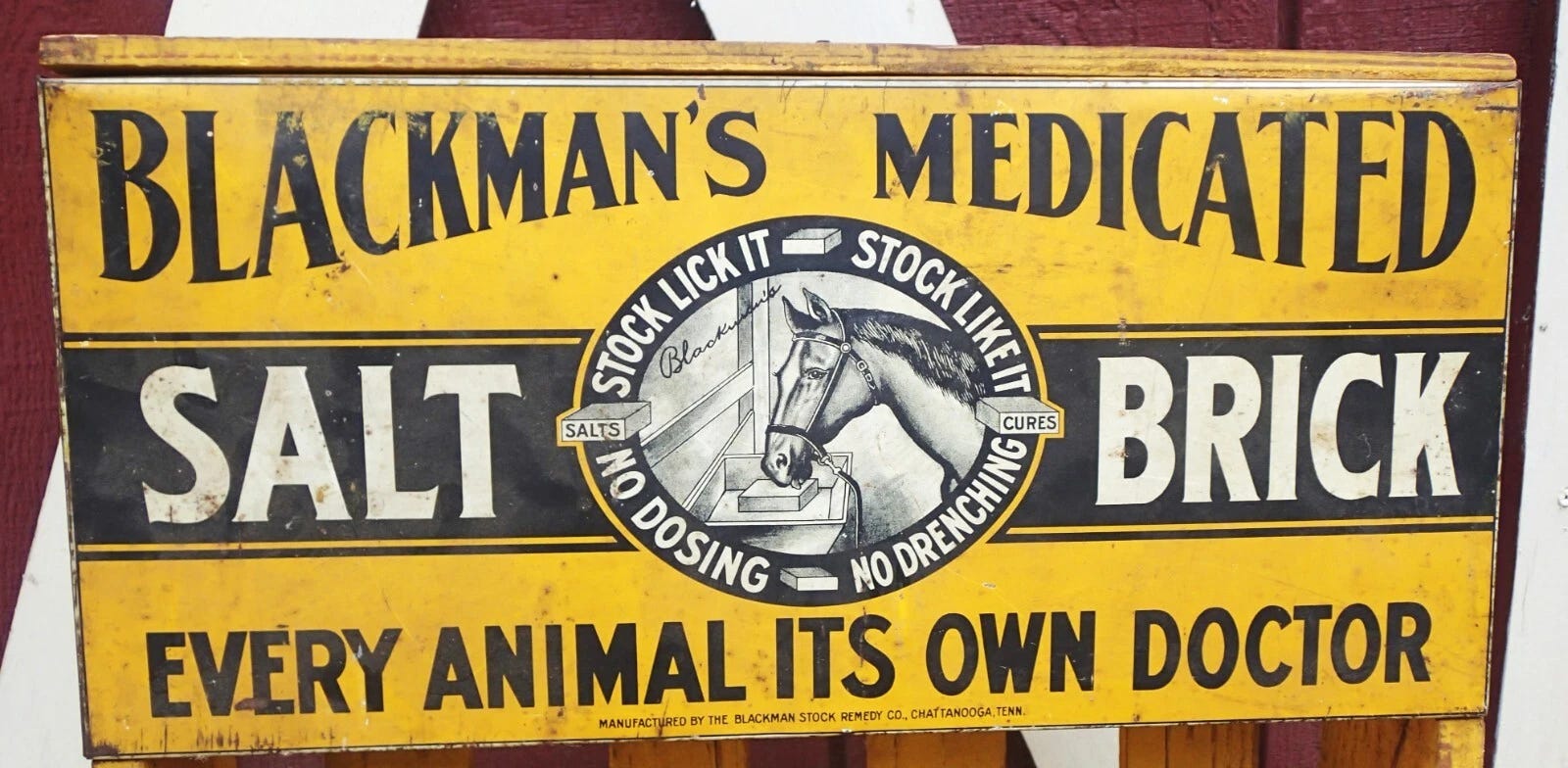
Let’s start with the the amazing advertising sign shown above. How much do I love it? Let us count the ways;
I love the term “salt brick.”
I love the slogan “Every Animal Its Own Doctor.”
I love the phrases “Stock lick it, stock like it” and “No dosing, no drenching.”
I love how the center oval is anchored by four little brick icons.
I lovelovelove the illustration of the horse gently licking the salt brick.
If you’re as fond of this sign as I am, it’s available on eBay, but it’ll cost ya.
Fun with Demonyms
A demonym is the term applied to people from a particular place. A person from New York, for example, is a New Yorker. A person from the UK is a Briton. And so on.
But what is the proper demonym for somebody from Las Vegas? I’d never thought about this until last weekend, when I attended a vintage ephemera show in Pennsylvania and saw this 1953 publication:
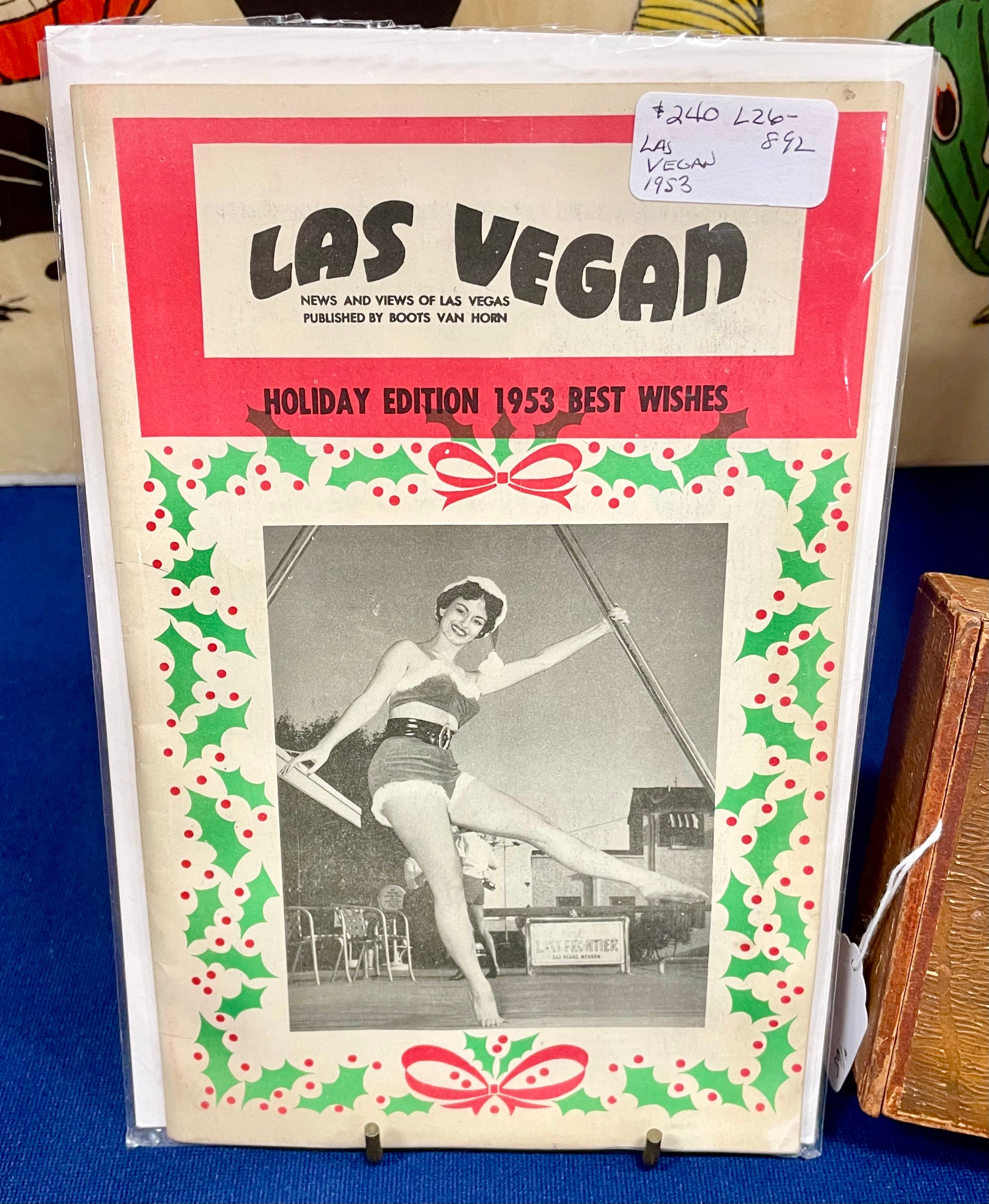
I double-checked and, sure enough, “Las Vegan” is indeed the official demonym for Las Vegas. Obviously, it resonates differently today, when “vegan” has achieved its own cultural currency. In fact, the city of Las Vegas, which was founded in 1905, is signicantly older than the term “vegan,” which was coined in 1944.
More Vintage Ephemera
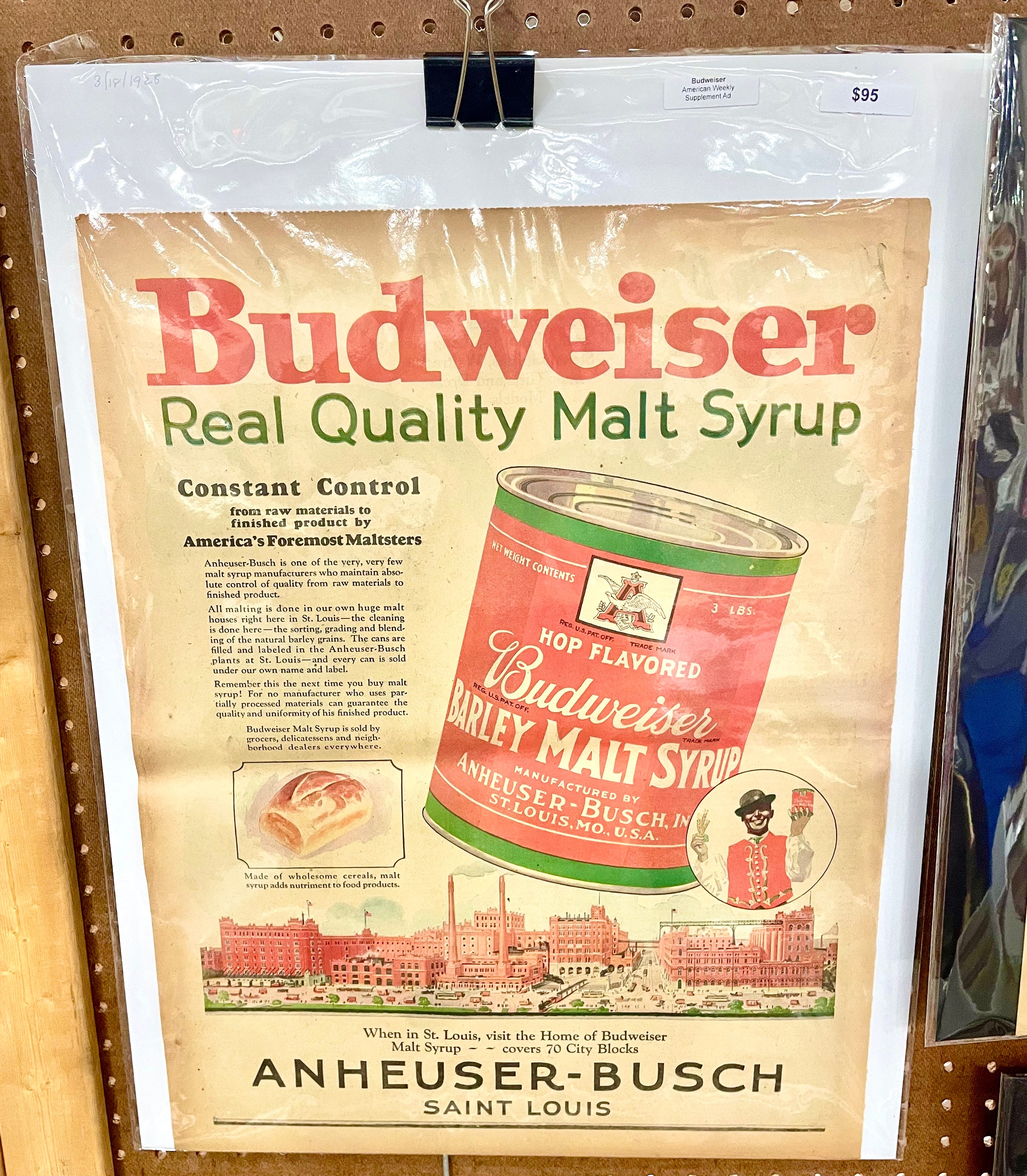
Prohibition, which was in effect from 1919 through 1933, was a disaster for America’s breweries and distilleries. Many of them went out of business, but the bigger ones tried to hang on by diversifying. The old print ad shown above, which I saw at that same ephemera event, is a great example of this, showing one of the survival strategies taken by Anheuser-Busch.
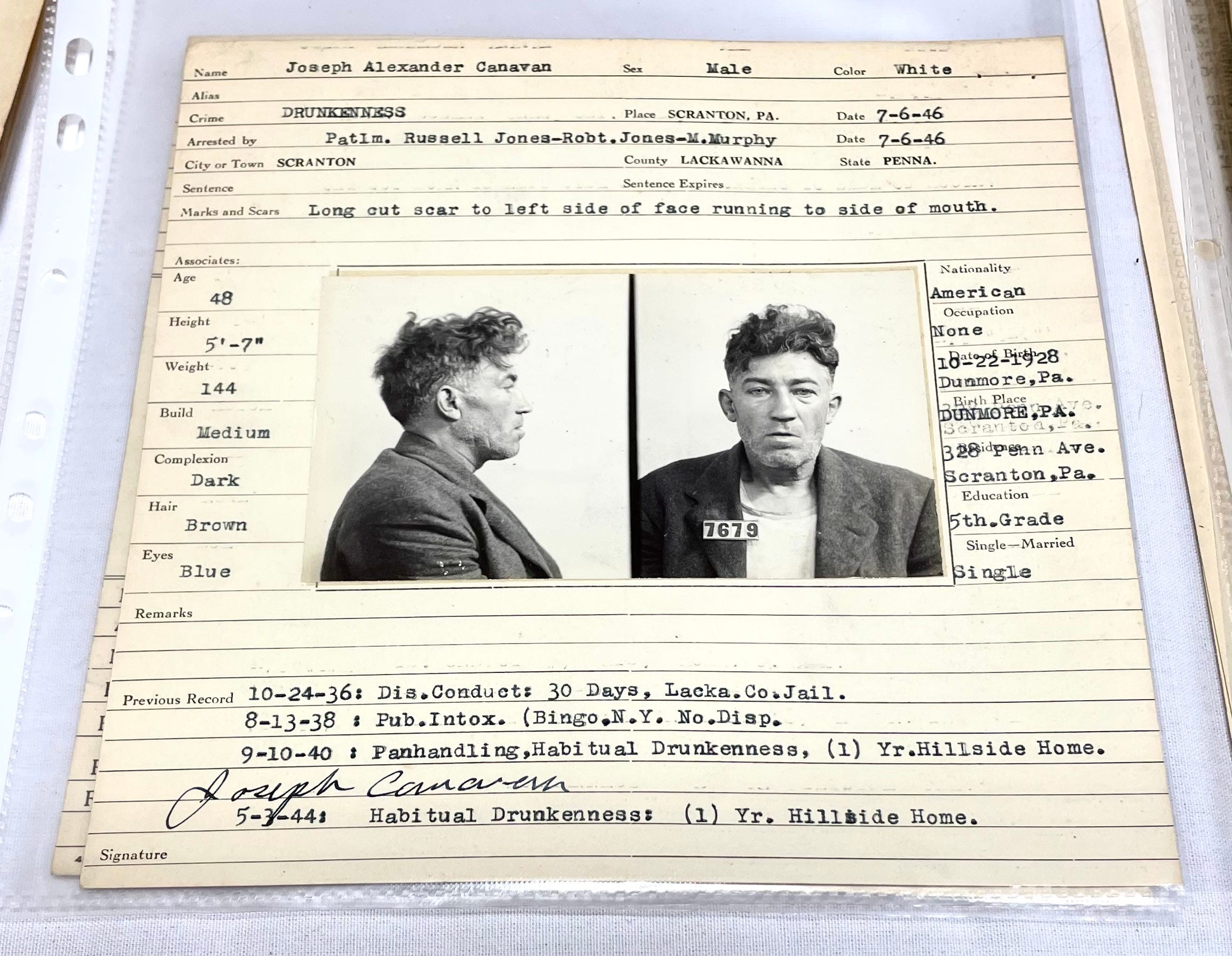
I also saw this very evocative police mug shot:
I didn’t purchase any of those items, but I did get this excellent 1962 mini-poster (11″ by 14″) put out by the International Apple Association (only $5!):
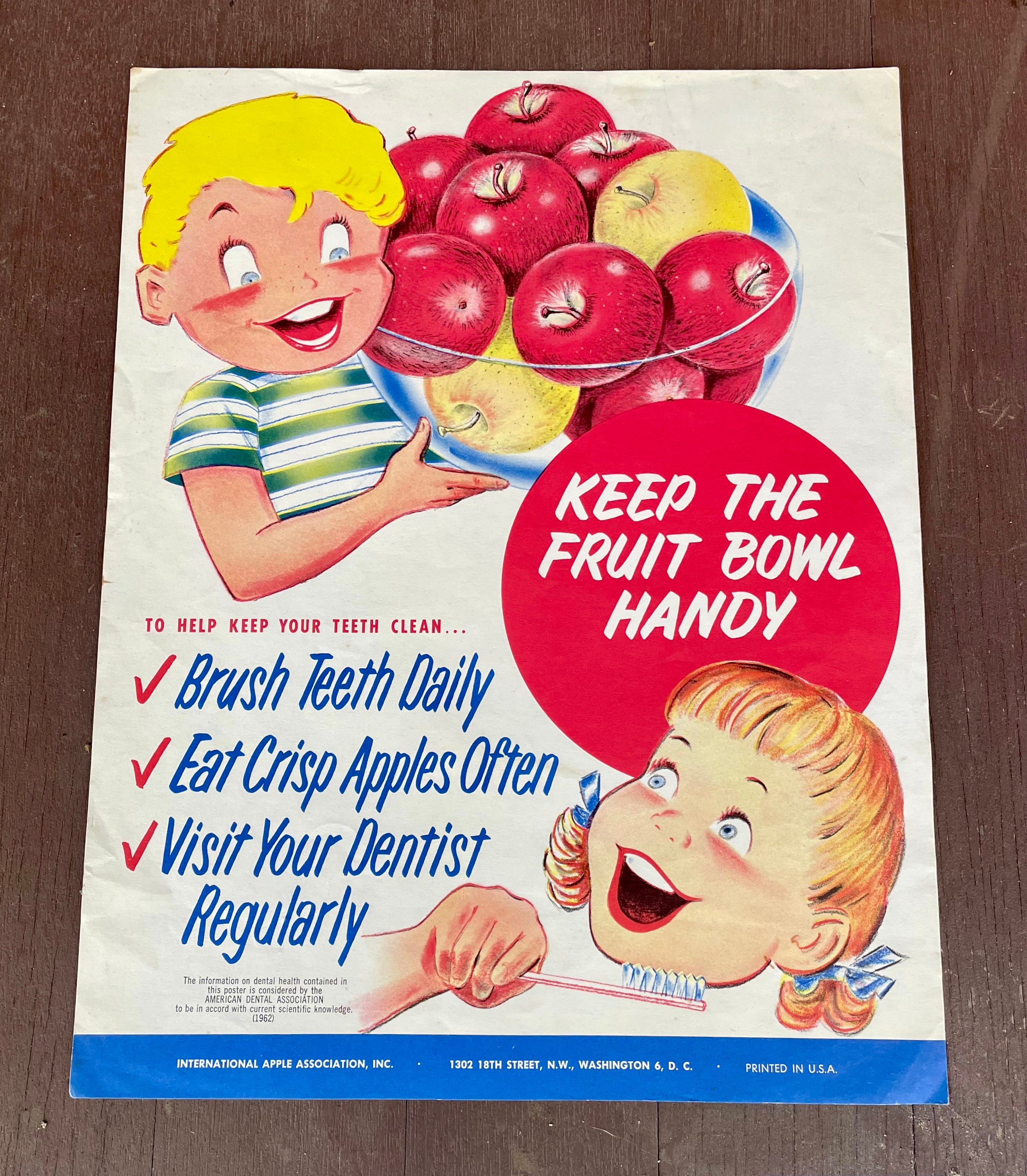
Since it’s about eating and also dental health, it would be suitable for either my kitchen or my bathroom. But the bathroom walls are pretty near capacity, so this item will be displayed in my kitchen once I get a frame for it.
I also got these fun Dixie-style paper cups promoting various soft drinks ($1 apiece):
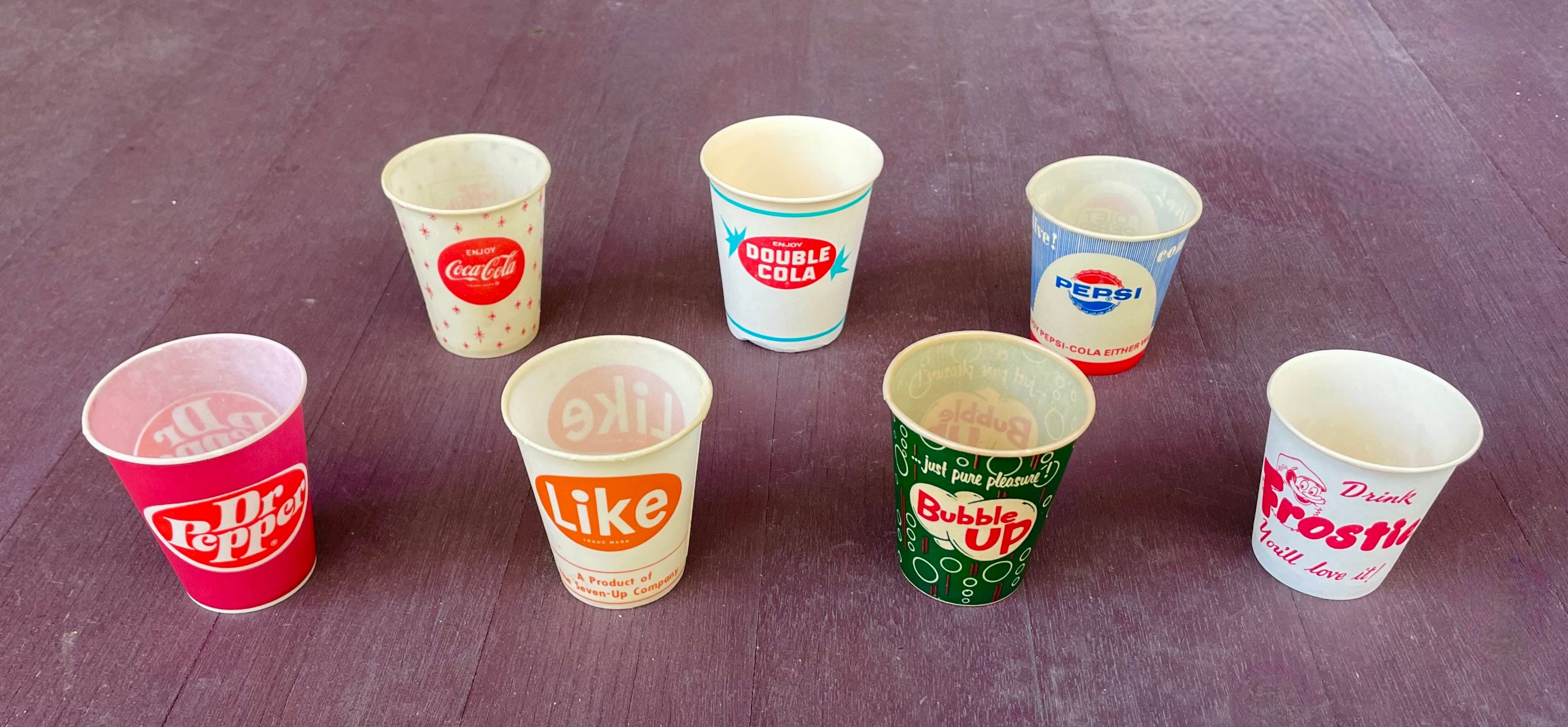
I’m thinking these might make a good stocking stuffer for someone, or maybe I’ll keep them. We’ll see!
An Odd Way to Chart a Brand’s History
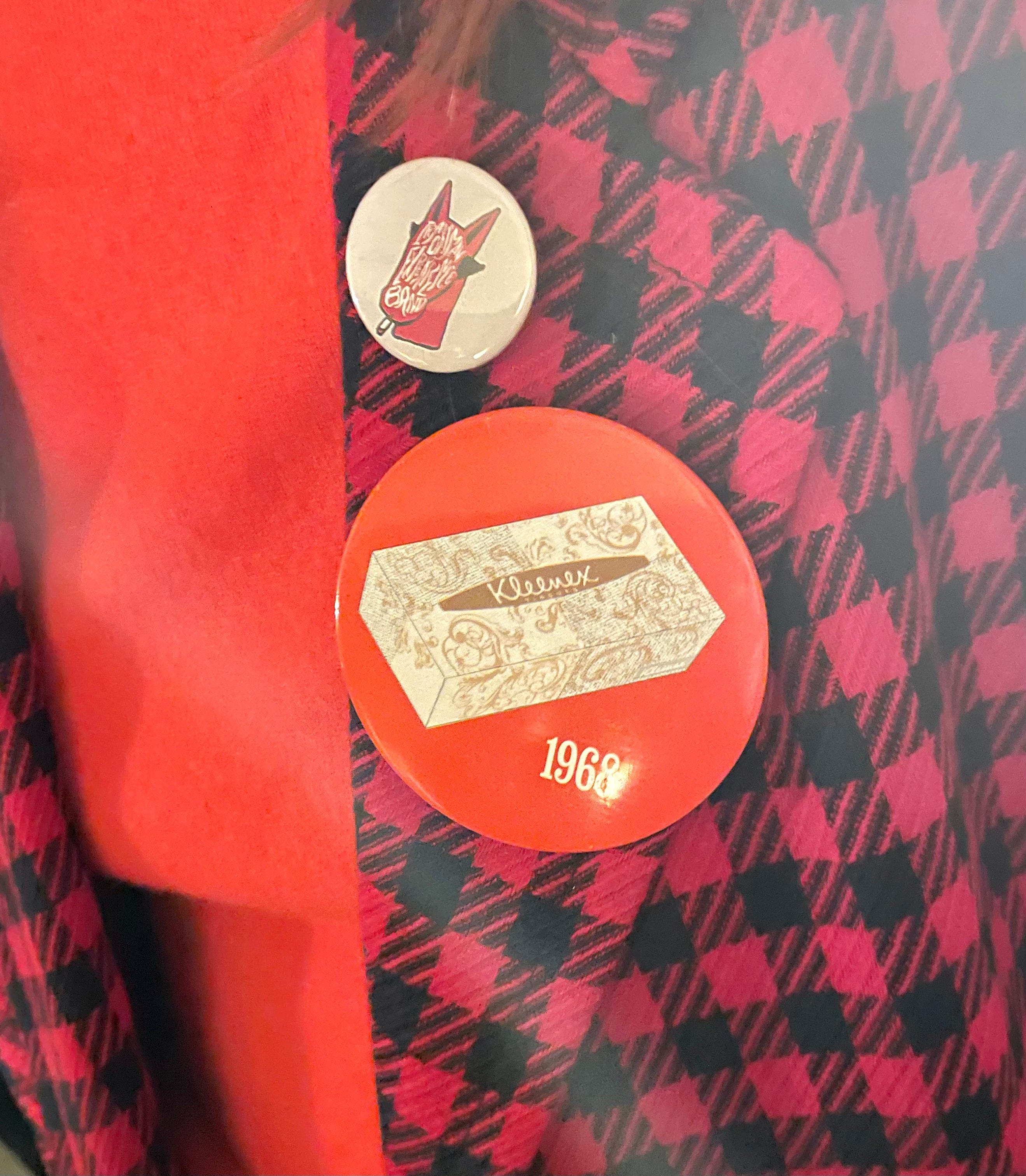
I recently met someone who was wearing a pin showing a box of Kleenex and the year 1968. I asked her about it and she said it was part of an old series of “Kleenex timeline” pins.
That was new to me, so I poked around a bit and learned that Kleenex put out a set of eight pins in 1968, each one featuring a box design from a specific year in the brand’s history. Here’s the full set:
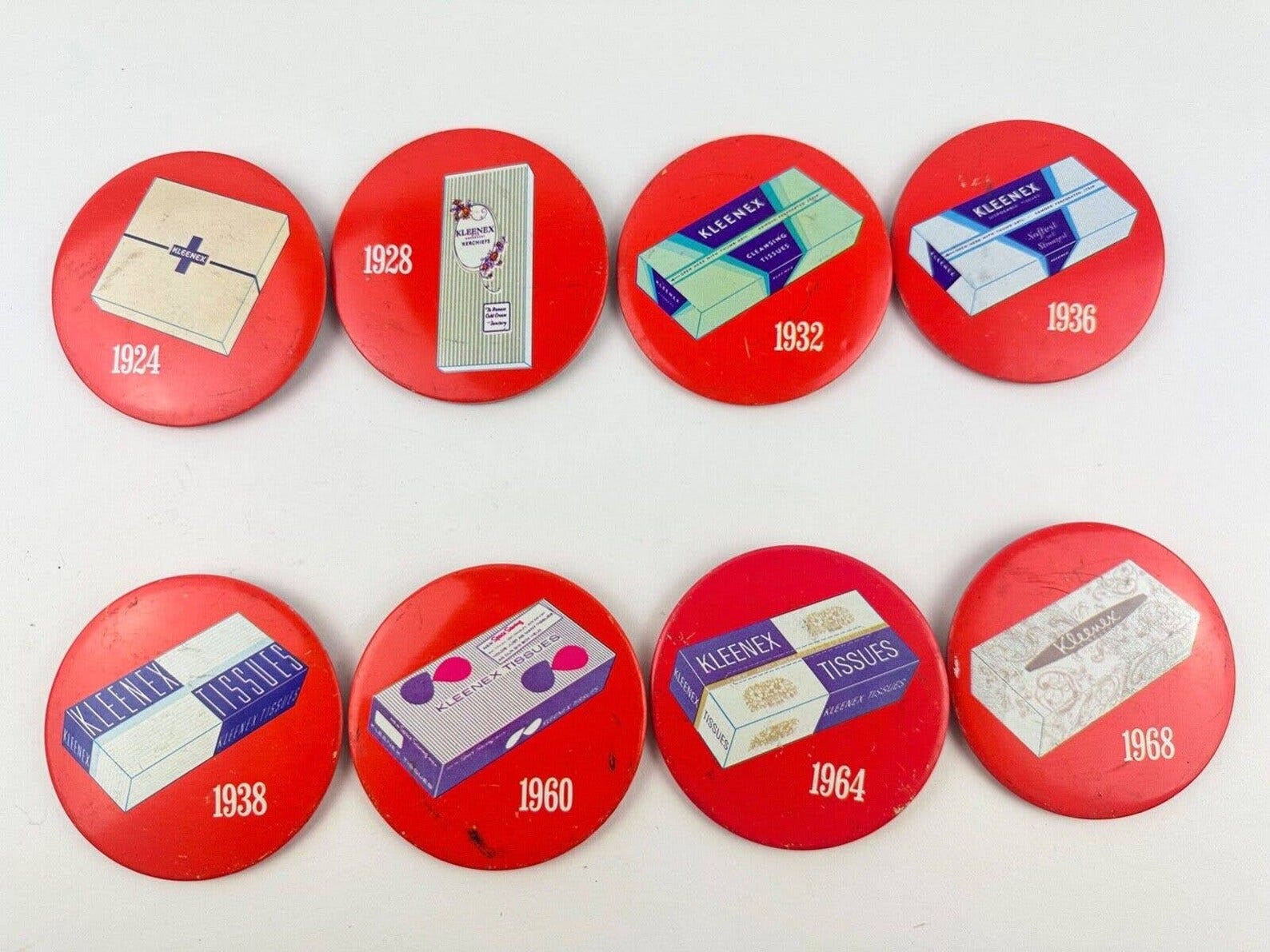
Pins seem like an odd way to showcase a brand’s progression (imagine trying to wear all eight of them), but I’m a big fan of package design, design history, and “collect ’em all” promotions, so these pins get a big thumbs-up from me.
The Price Is Weird
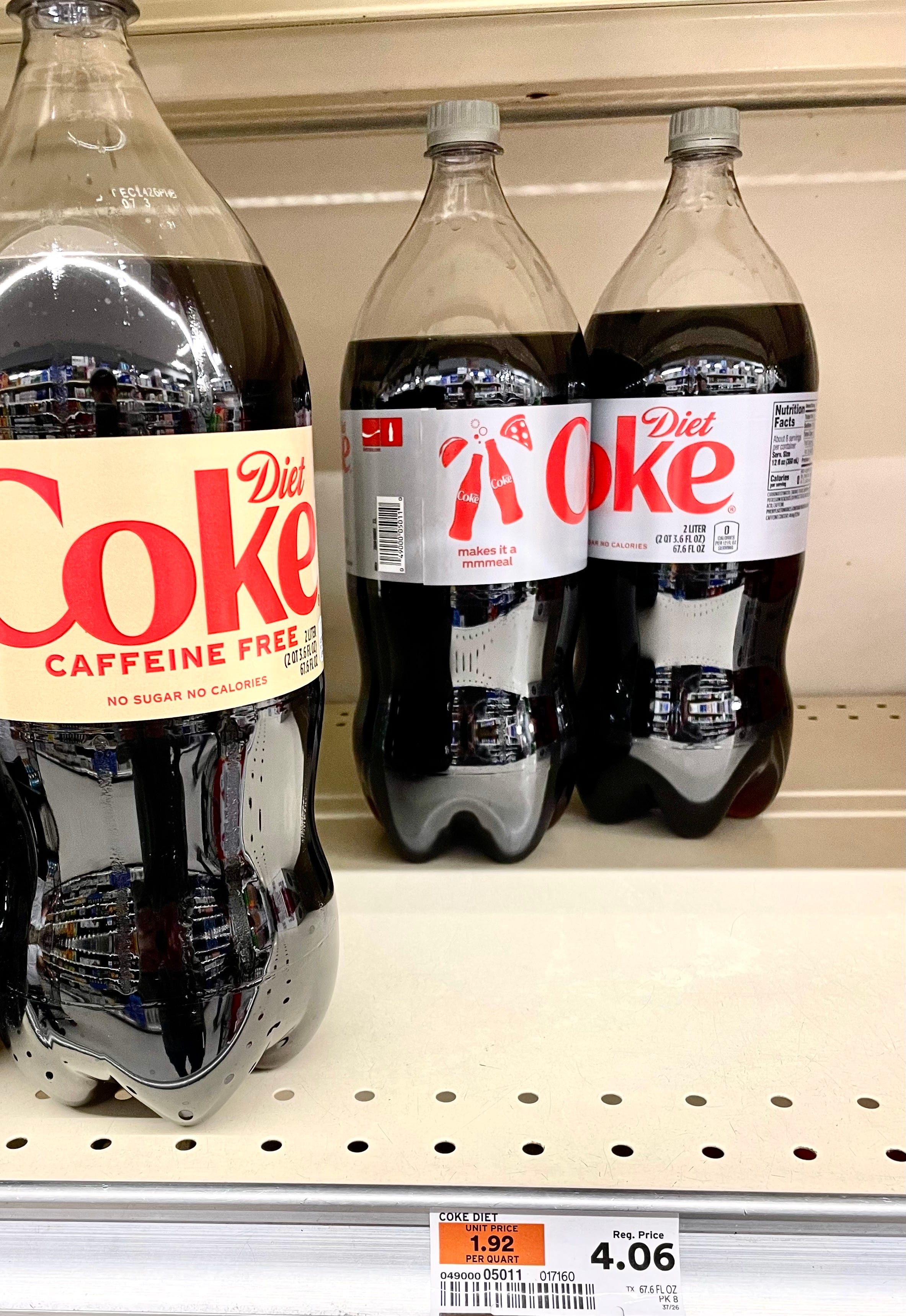
I was at my local supermarket the other day and was surprised to see two-liter bottles of Coca-Cola products priced at $4.06. Aside from being outrageously expensive, it’s such a strange price point. Like, aside from things that are priced by weight (meat, produce, etc.), how often do you see any supermarket price that ends in a 6, much less 06? So strange that they didn’t just round down to $3.99.
Fun with Menus
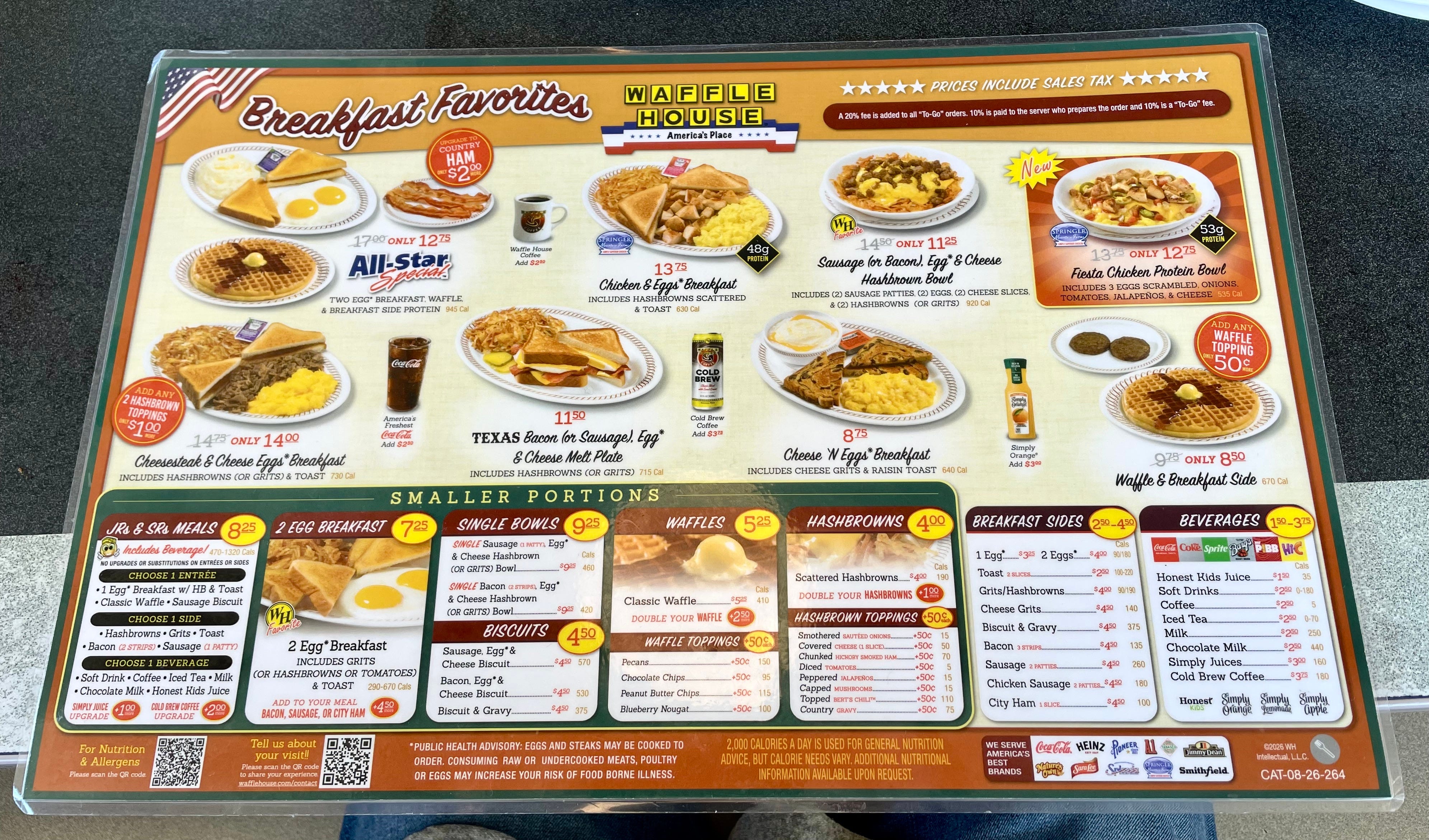
Speaking of price points, while attending that ephemera fair in Pennsylvania, I stopped at a local Waffle House — my first time at one of their outlets since before the pandemic. It’s a little hard to see in the photo shown above, but I noticed that every single menu item had a price ending in .25, .50, .75, or .00. Even more surprising (at least to me) was the note at the top-right edge: “Prices include sales tax.”
This means that the total price of every check at this Waffle House will end in a multiple of 25 cents, so the only coins they have to keep in the cash register drawers are quarters. That presumably speeds transactions at the register and also makes it easy for the cashier to calculate the combination of coins needed for the proper change.
I rarely go to chain eateries (pretty much the only ones I’ll patronize are Waffle House and White Castle), so maybe this quarter-centric, tax-inclusive pricing format is common and I’ve just been out of the loop. Anyone know more?
A very different approach to pricing can be found on the menu of Pablo’s Restaurant, a diner in my neighborhood. Like a lot of eateries, they like to use price points that end in .95 — except when they don’t:
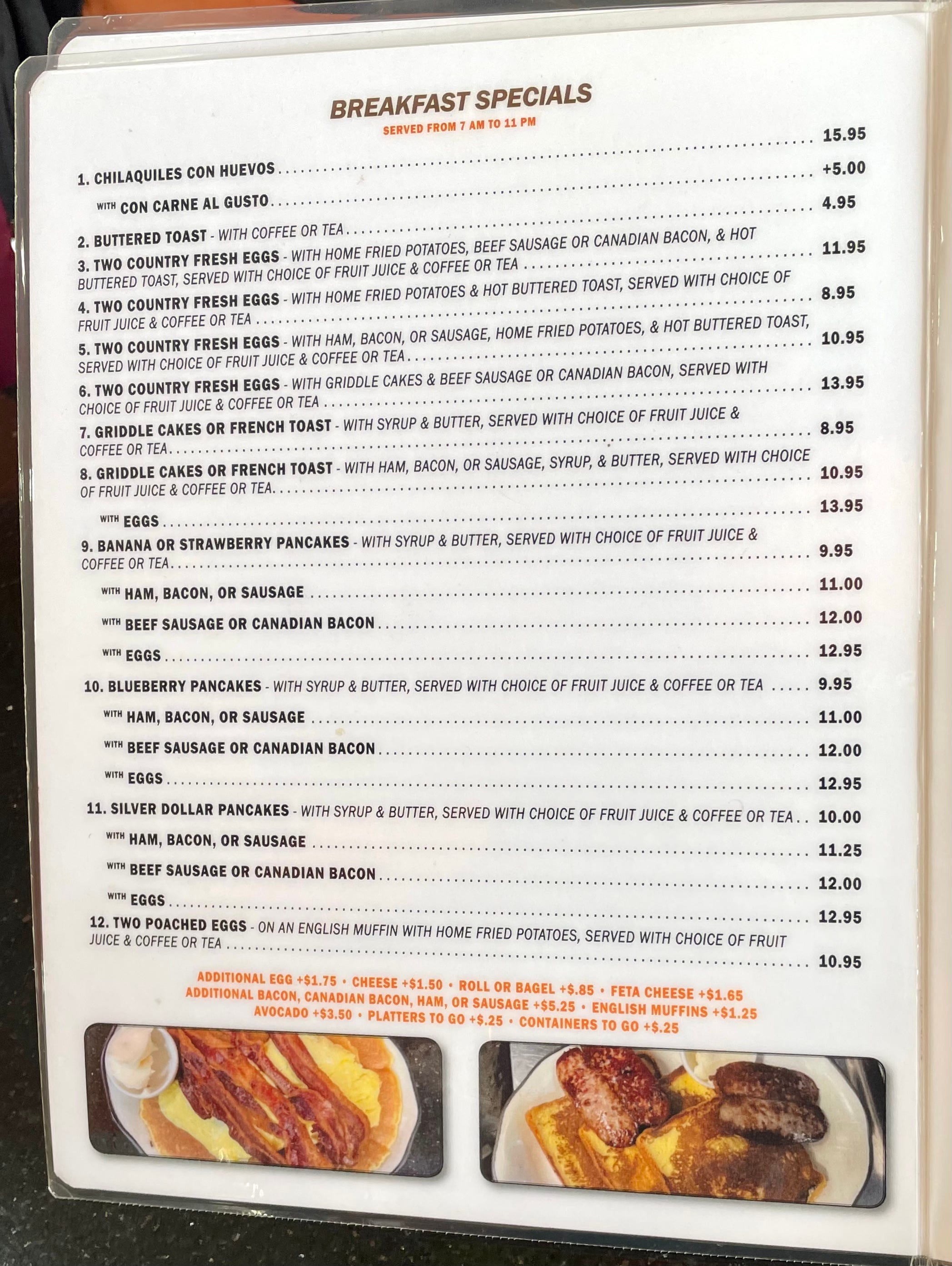
So strange that they keep bouncing back and forth between prices that end in .95 and others that end in round dollar amounts!
One other menu note, not related to pricing: During that same Pennsylvania trip, I stopped at a place called the Crossroads Hotel, whose menu featured something I’d never seen before. Look at the last pizza topping listed here:
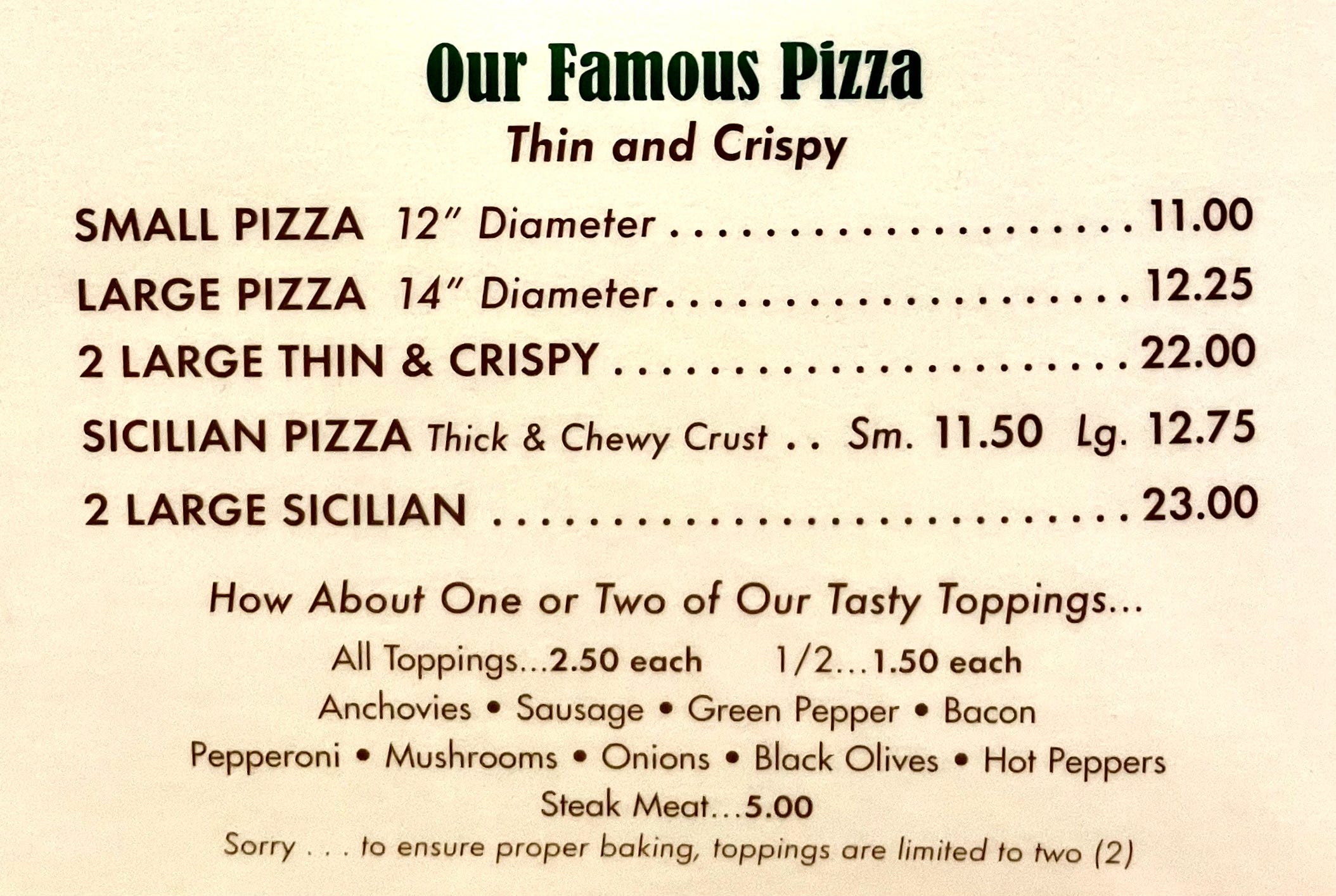
“Steak Meat”! Definitely the first time I’ve encountered that phrase on a pizza menu. This place also serves Philly-style cheesesteaks, so I’m pretty that’s what they were referring to, but it’s still an awkward-seeming term for a listing of pizza toppings.
Insulator/Crossarm Follow-Up
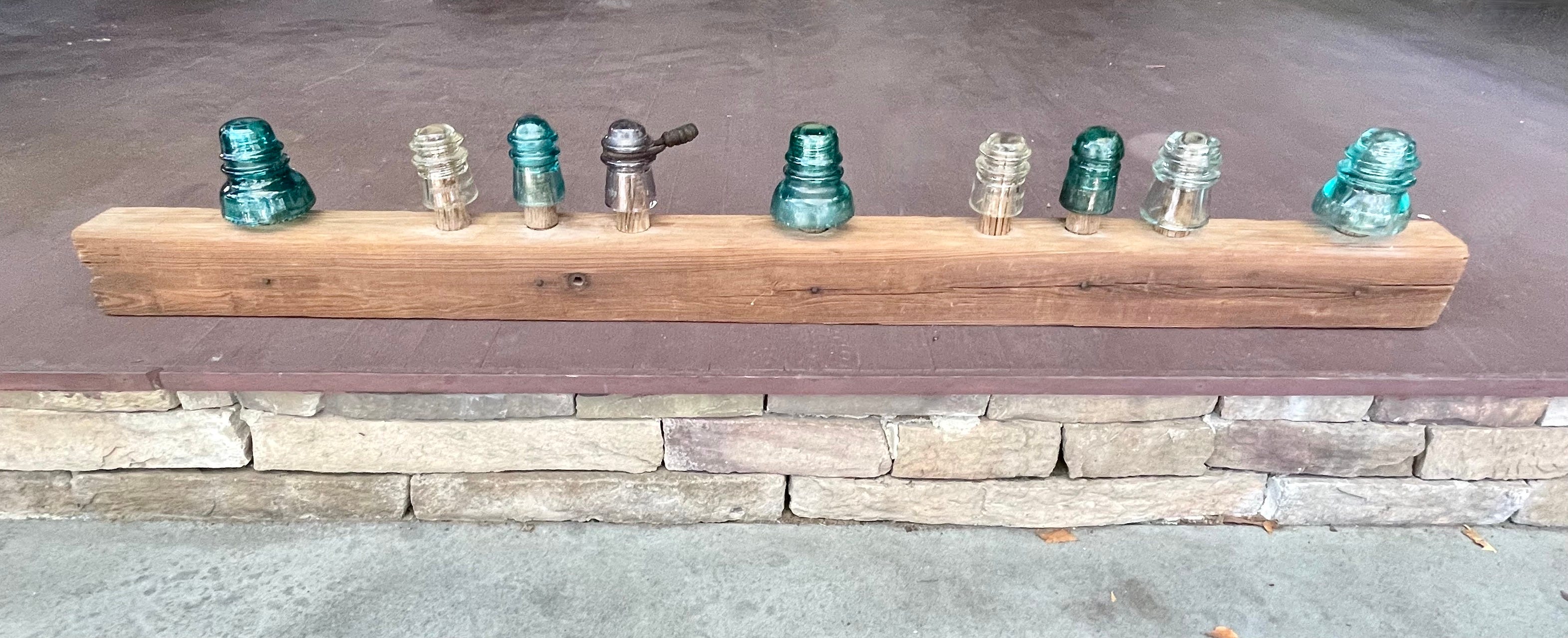
Remember how I recently acquired a bunch of vintage glass insulators mounted on their original utility pole crossarm? I had initially planned to display the whole assemblage on the back of my sofa, which looked pretty cool, but then I noticed that the wooden beam was giving off a gasoline-like smell, apparently because it had been treated with creosote as a preservative, which was standard practice for old utility poles. So I put the beam outside while I tried to decide what to do with it.


Shortly after that piece ran, I received an email from IC reader Mike Wilson, as follows:
Both my parents were linemen for Bell of Pennsylvania. (In fact, my mom was the first female lineman ever in Pennsylvania.) So I sent them your post because they have insulators and other phone company items that they’ve saved.
The first thing both of them said was, “That’s not a real crossarm.” I asked them why, and here’s what they said:
A real crossarm wouldn’t have a hole in the top middle.
The wooden pins that the insulators screw onto are too close together. Thus, the insulators are too close. “You’d never be able to get the wire through,” said Mom.
There’s no hole in the side to attach it to a pole. This hole would be ⅝″.
It should have two holes on the sides to attach metal straps. These straps would attach on each side of the crossarm with a ⅜″ carriage bolt and then run down at an angle and attach to the pole with a lag bolt, forming a triangle. Also, the straps would leave marks and “dents” in the crossarm.
My mom said it just doesn’t look old enough.
Hmmmm. But if it wasn’t a real crossarm, why was it giving off industrial fumes? “My parents think someone could have coated or soaked a random piece of wood with creosote because they planned to display it outside,” said Mike.
So my vintage “crossarm” isn’t safe to keep indoors and isn’t even the real deal — a lose-lose. There’s no point in keeping it, so I’m gonna toss it.
As for the insulators, they’re still nice, and I suppose I could buy a new piece of lumber and rig up a display similar to the other one, minus the toxic fumes. But the only reason I wanted the insulators in the first place was that I thought they were mounted on a genuine utility beam. Now that Mike and his parents have crushed that dream (kidding) (mostly), I don’t really feel like keeping the insulators, so I’m giving a few to friends and selling the rest.
All in all: a fun adventure, even if it didn’t turn out the way I’d hoped.
Brannock/Scholl Follow-Up
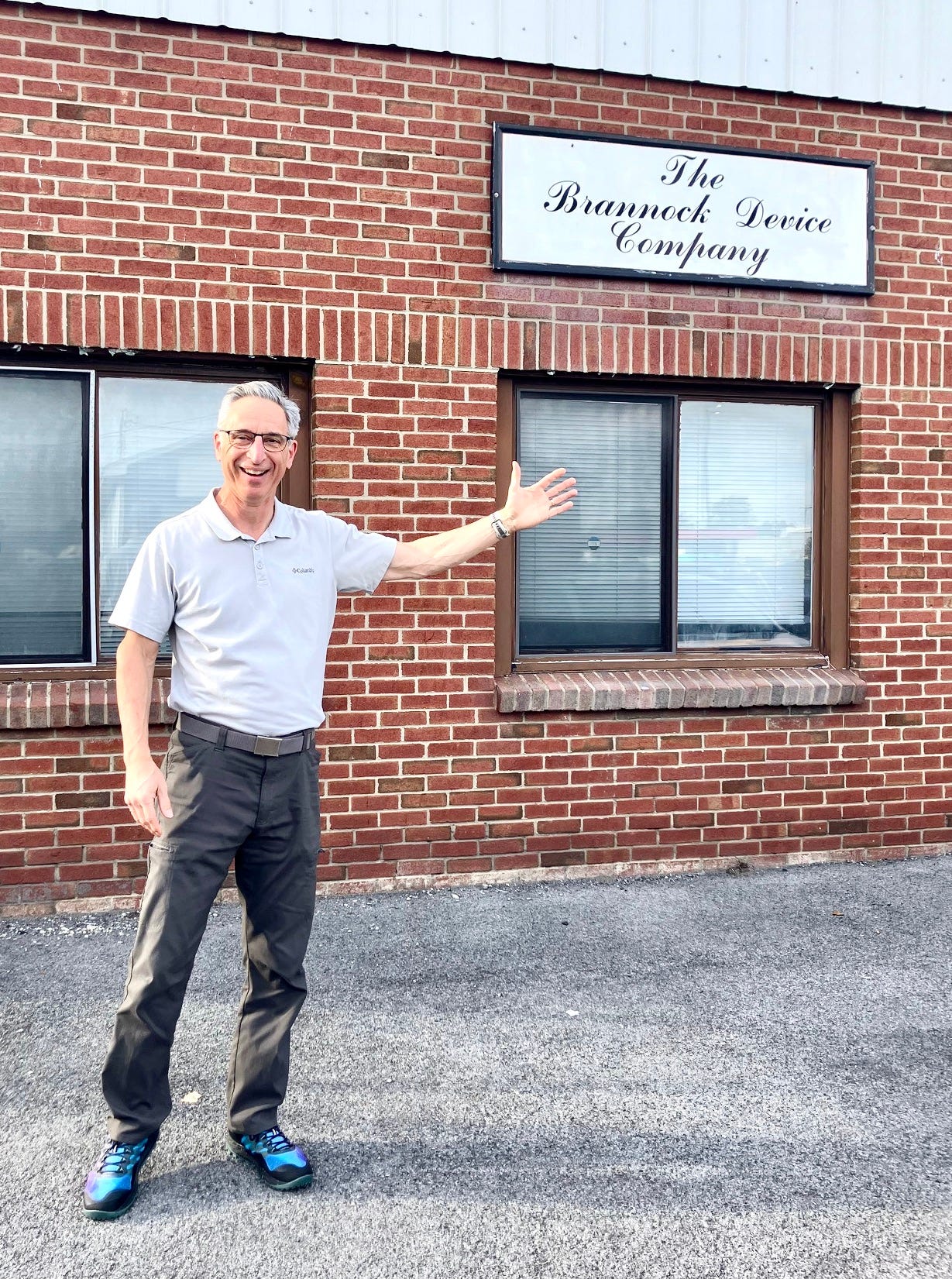
Remember my recent look at Dr. Scholl’s version of the Brannock Device? On the day that article was published, IC reader Nick Kissoff and his wife, who live in Ohio, were driving through upstate New York to visit their son. Nick was reading the Brannock/Scholl article on his phone while his wife drove, and he suddenly realized that they were fairly close to the Brannock Device Company’s headquarters, which is just outside of Syracuse. It all seemed like kismet, so they made a quick pilgrimage, resulting in the photo shown above.
Even better, as Nick and his wife were taking the photo, they encountered Brannock CEO Tim Follett, who was just closing up shop for the day. “He seemed a bit puzzled and bemused that someone from Toledo was getting photographed in front of his business,” says Nick. “But after we explained why we were there, he was genuinely happy we were interested and said that he knew you. He also said he wished we had stopped by earlier so he could have given us a quick look-see at things. He says hi!”
How great is that? What a story!
That seems like a good one to go out on. Hope you enjoyed this assortment of short items!
Paul Lukas has been obsessing over the inconspicuous for most of his life, and has been writing about those obsessions for more than 30 years. He also writes Uni Watch, which is sort of like Inconspicuous Consumption for sports. You can contact him here.
Is that the Crossroads Hotel in Hellertown, PA, near Lehigh University? My friends and I grew up nearby and frequented the establishment for their cheesesteaks, long ago during high school. I remember the dining room had dark wood paneling and an enormous swordfish mounted on the wall.
Who ever wrote up that mugshot card either can't add or entered their birth date wrong (no one is 48 when born in 1928...)