

Note: This post is not paywalled. Enjoy! — Paul
Remember “Lexi,” the Ohio woman who meticulously logged all the mail she sent and received over a 10-year period? One thing I loved about that project, aside from its niche-specificity, was its obsessive sense of completism. Lexi had an inner drive to document every single mailpiece in her life. Similarly, we recently learned that IC reader Bob Andrews is driven to record every single gas fill-up for his car. For people like Lexi and Bob, “almost” isn’t enough: They are completists.
Still, as completism goes, car refueling and postal activity are relatively small-scale pursuits. What if you wanted a more ambitious completist project? Something like, for example, documenting every single thing you own?
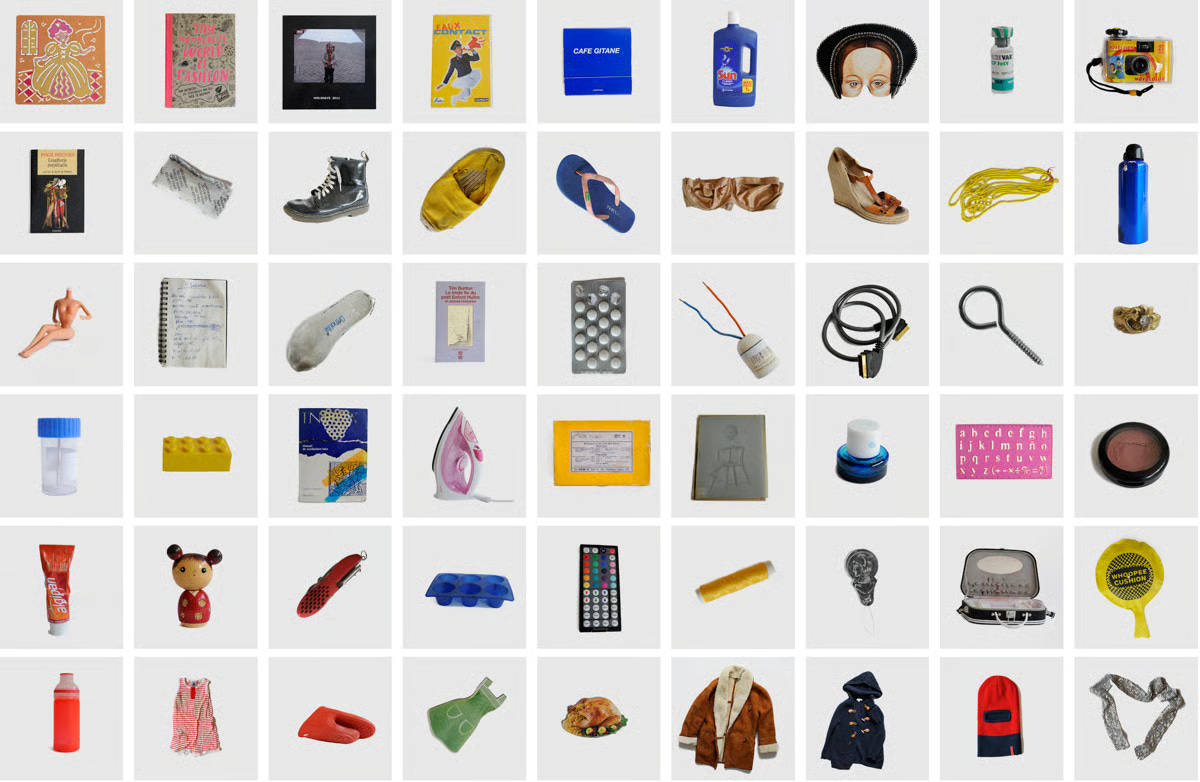
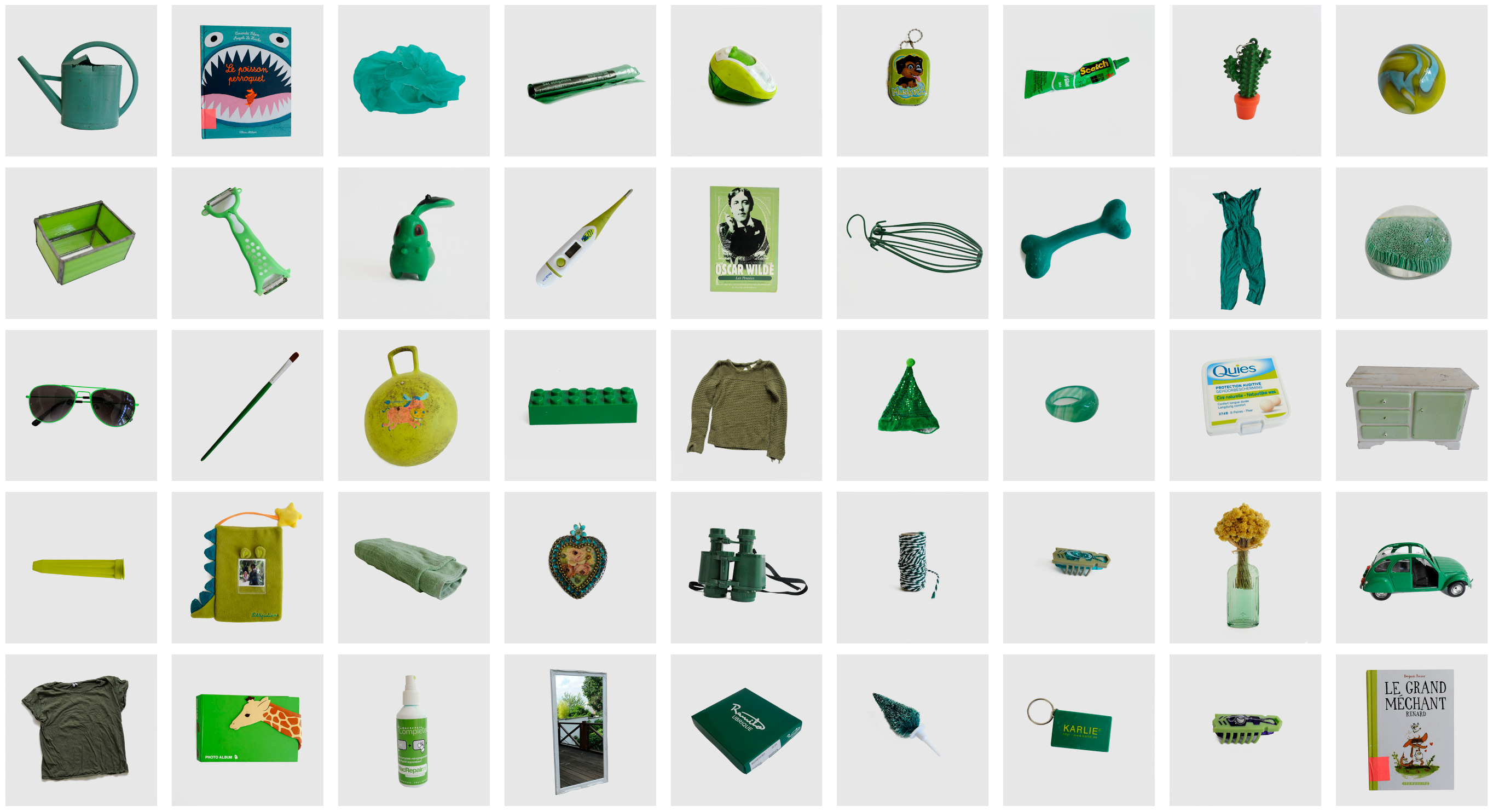
I recently learned about several people who have tried to do just that. One of them is the Belgian photographer Barbara Iweins, who in 2015 decided to photograph every object she owned, creating a sort of catalog of her material possessions (you can see a small sampling above). On her website, she describes the project like so:
As a neurotic collector, collecting, ordering, categorizing, and exhibiting things have always given me immense pleasure. I think that I am mainly looking for an aesthetic emotion in the assemblage of things (or ideas) that at first glance might seem incongruous or even tasteless.
I'd like to keep things as they are, but my adult life decided otherwise. After many moves and a sudden divorce in 2015, I left Amsterdam and came back to live in Brussels with my three children under my arm.
Longing for more stability in my life, I felt the urge to really lock myself into my new place. I decided then and there to push the limits of my inertia and neuroticism by getting up close and personal with my belongings and analyzing all of them in detail.
From then on, for four years, room by room, drawer by drawer, I photographed, indexed and classified my entire house. Absolutely everything: from my daughter’s torn sock to my son’s Lego, but also my vibrator, my anxiolytics... absolutely everything.
Iweins photographed 12,795 objects during her four-year project. You can see all of them on her website (it takes a little while for the full set of pics to load), where you can also sort them by color, by material, by room, and so on. It’s an impressive project, and a fun interface.
Iweins’s completist approach to documenting her material possessions may have been influenced by the British artist Simon Evans, who in 2009 created a piece called Everything I Have, which documented, well, everything he had:
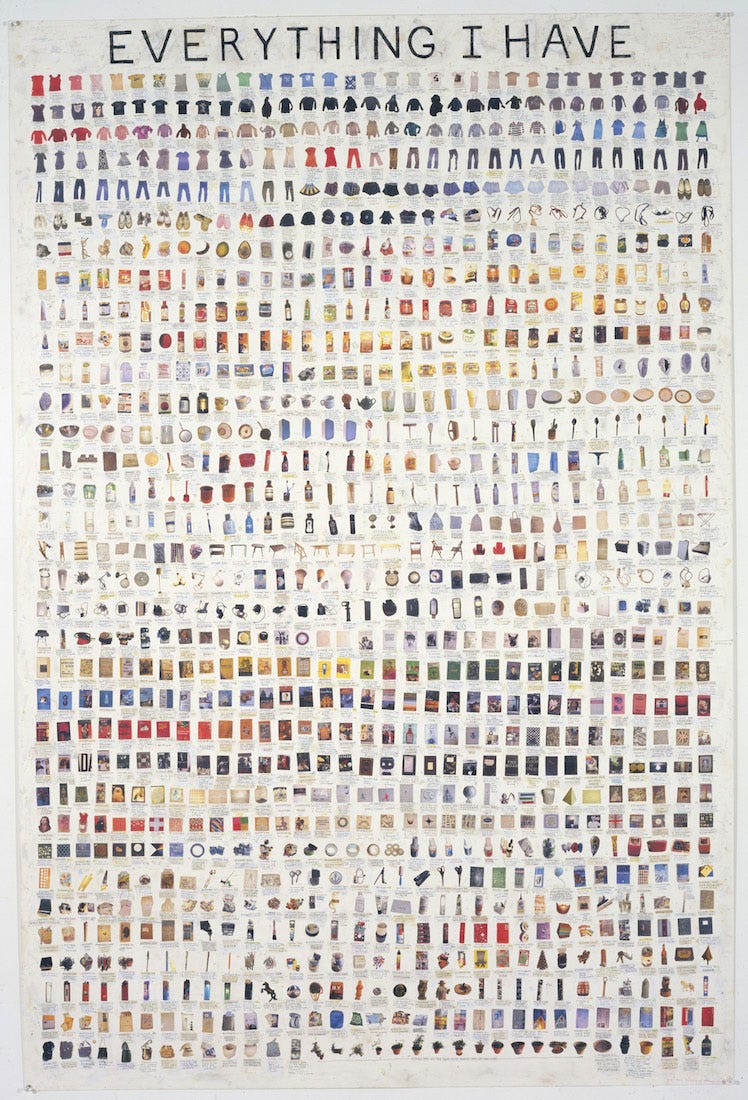
At first glance, Everything I Have looks like a bunch of tiny illustrations. But if we zoom in, you can see that it’s actually a cut-and-paste assemblage of photos and captions. Here’s a closer look:
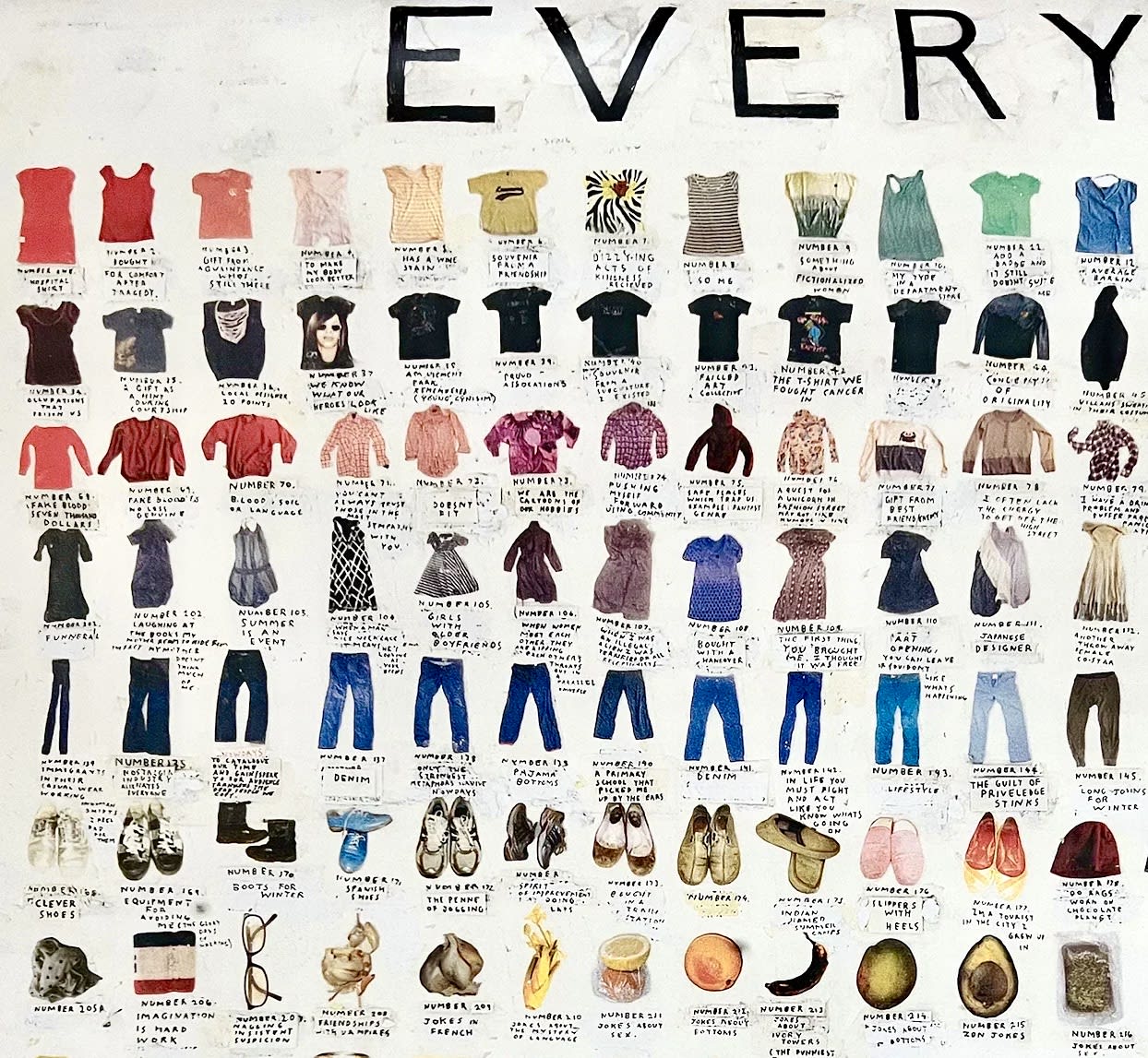
Evans’s completist compendium covers 1,112 items — a mere drop in the materialist bucket compared to Iweins’s 12,795. It’s not clear if Evans had fewer possessions than Iweins and/or if he applied a less rigorous recordkeeping protocol. Perhaps, unlike Iweins, he didn’t feel the need to include his sex toys or his children’s torn hosiery. Either way, it’s satisfying to see all of his items (or at least what he claims to be all of them) compiled into one artwork.
Cataloging one’s worldly possessions raises a lot of questions. For starters, your personal inventory is constantly in flux. Every time you go to the supermarket, pick up a new ChapStick at the corner store, or get your daily mail delivery, you suddenly have more objects; every time you take out the trash, sell something on eBay, or eat an apple out of the fridge, you have fewer. So even when you “finish” the project of documenting “everything,” you’re never really done.
Then there’s the question of quantitative enumeration. Is a six-pack of beer one item or six? If you have a three-pack of paper towel rolls but three loose rolls of toilet paper, should they be counted the same or differently, and why?
I was thinking of exploring these issues with Evans and Iweins. But then, in a bizarre coincidence, I learned that someone in my own Brooklyn neighborhood was in the process of — wait for it — documenting all of her possessions! This incredible happenstance presented itself to me about a month ago, when a woman named Bayyina Black posted the following message to my local Buy Nothing group on Facebook:
Hey neighbors!
I’m leaving New York at the end of April/top of May. Which means I have A LOT to give away.
I’m doing a project called The Story of My Stuff, where I’m documenting and archiving everything I own before I go. Think: home décor, books, craft supplies, clothes, bags, plants, kitchen items, toys, art supplies, and so much more.
She was beginning by getting rid of some books, which she had documented with identical camera perspectives:


I wanted to know more about Bayyina’s project, so I messaged her and asked if we could meet. She said sure, so a few days later — April 14th — I visited her apartment (about a 10-minute walk from mine) and talked with her for about an hour.
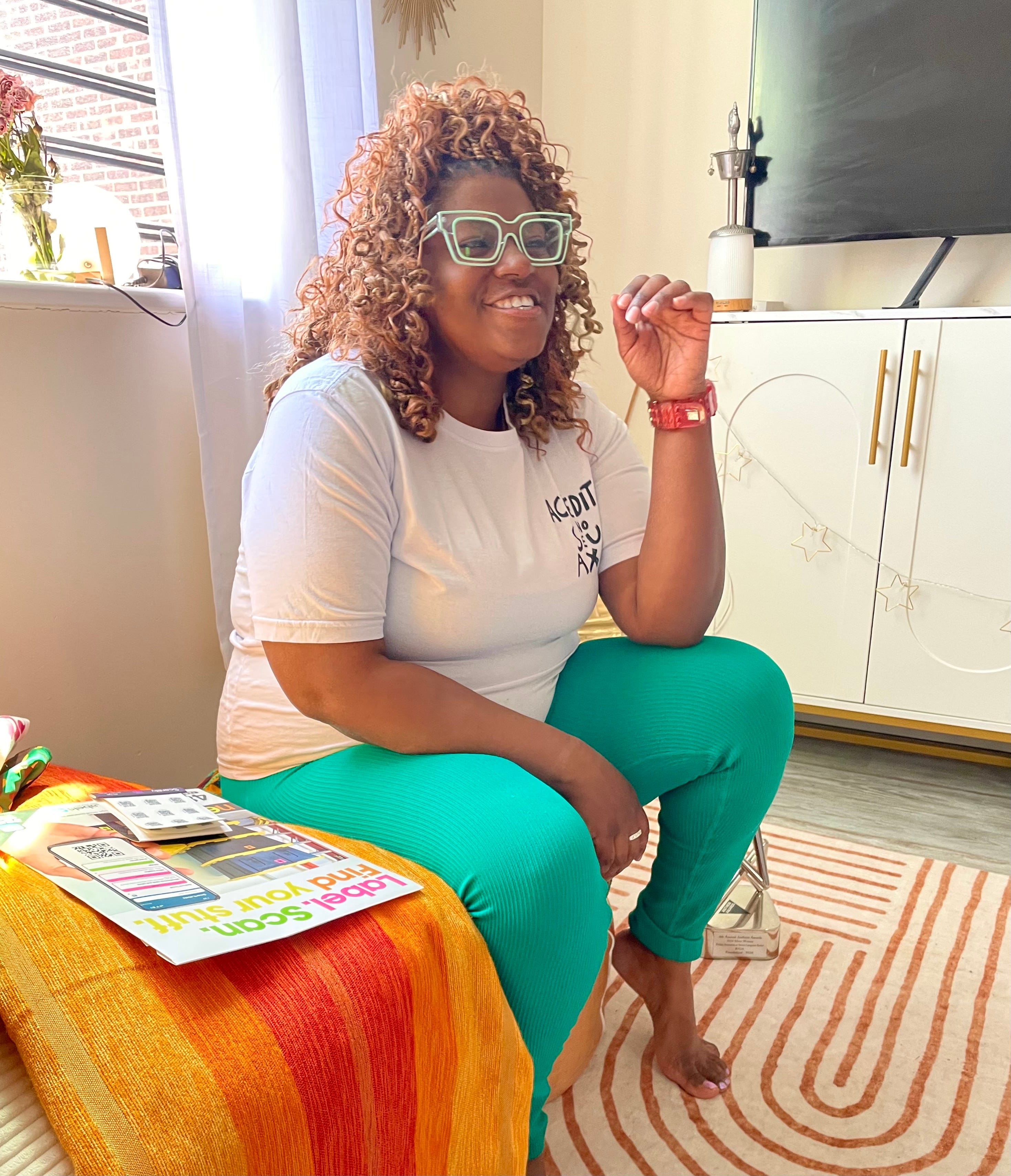
“I’m a maximalist,” she explained. “That means I have a lot of things — I like stuff, and I can get a bit obsessive about collecting things. It also means I dream really, really big.”
Like, say, dreaming about documenting an estimated 10,000 personal possessions — some in her home and some in a nearby storage unit — in less than a month. “It’s probably unrealistic, given the time frame,” she admitted. “It started because I have way too much stuff and I needed a dopamine-hit, instant-gratification way to figure out how to get rid of my things in a fun and engaging way. I also wanted to commemorate this season in my life and know what I had up to this point.” She said she’d been influenced by Marie Kondo’s decluttering manifesto, Spark Joy, and also by Christine Platt’s book The Afrominimalist’s Guide to Living with Less, which explores Black Americans’ complex historical relationships with material culture, class, and related issues.
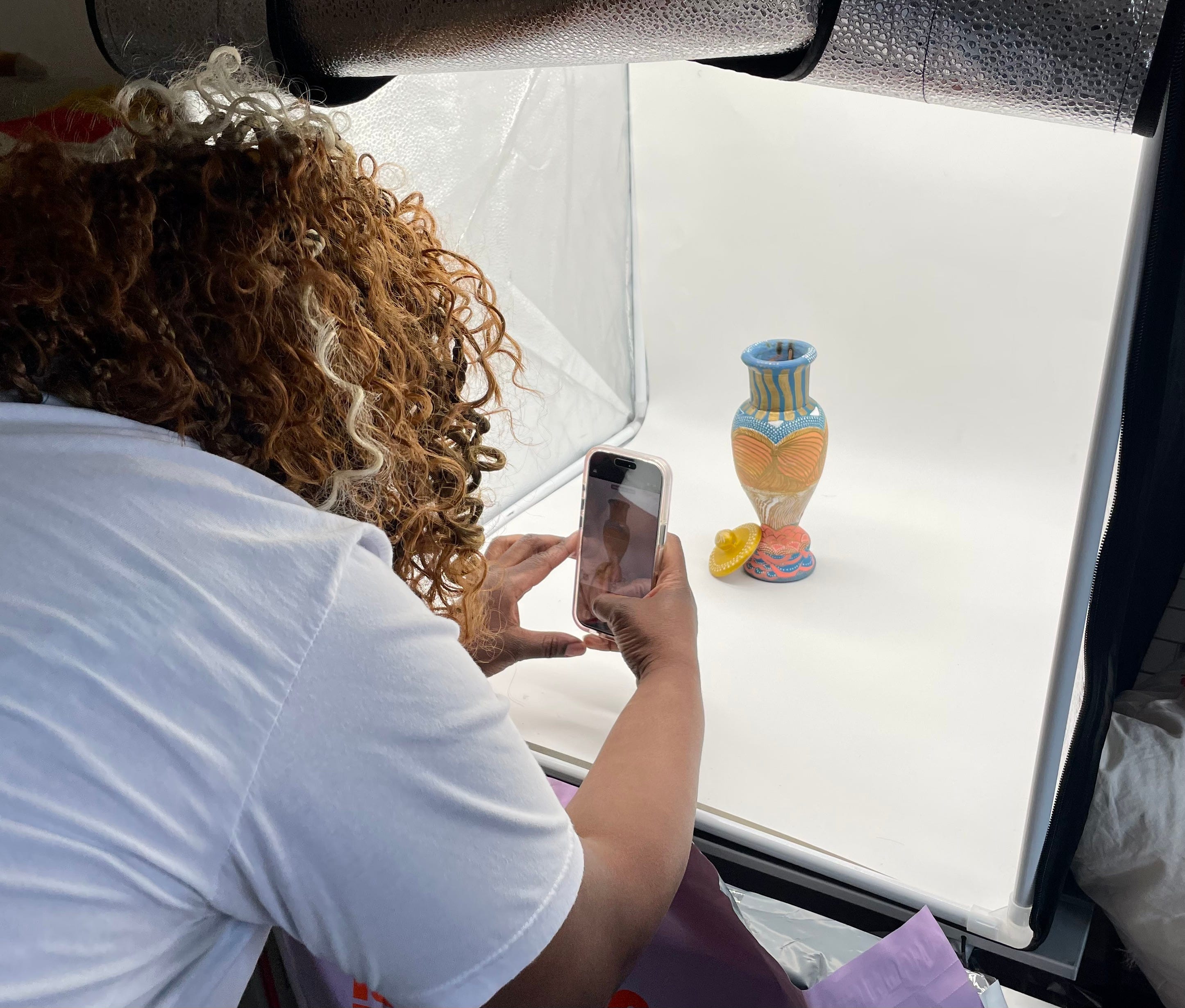
I checked back with Bayyina toward the end of April. She said time constraints had forced her to abandon the photo-documentation process soon after we met (not surprising) but that the abbreviated project had still been worthwhile, in large part because she was now more aware of her purchases. “I am a lot more mindful, and it has made me not buy something unless I absolutely need it.” That seems to be an implicit point behind all of these object-recording projects — to have a more thoughtful approach toward our consumption-based culture.
But it’s worth noting that not all cultures are as conspicuously consumptive as ours. As I worked on this article, I learned about a 1995 book by the photographer Peter Menzel, called Material World. It features portraits of statistically “average” families from 30 different countries, with each family accompanied by all their possessions. The range of material accumulation from one family to the next, based on cultural and economic norms, is fascinating. (You can see 18 of portraits from the book on Menzel’s website.)
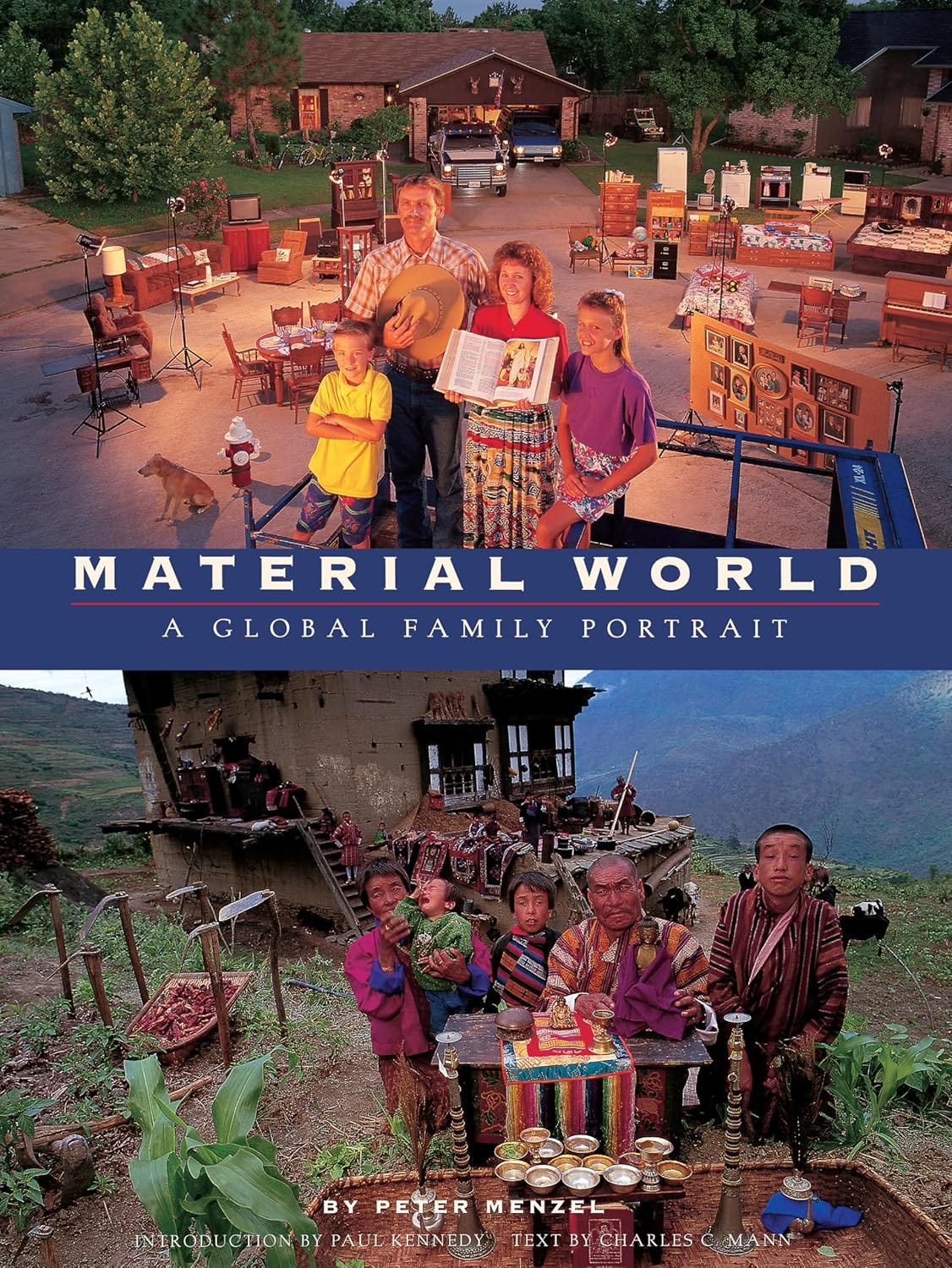
The book raises an intriguing question: How would you feel about being photographed with all of your possessions? Would you be proud? Ashamed? I’m guessing that for most of us — myself definitely included — it would be a mix of both. (The one thing I’m sure of, though, is that I’d rather be photographed with all my stuff than have to catalog all of it myself.)
If anyone out there has ever been moved to document all of their belongings, or to pursue any other sort of completist project, you know what to do. Thanks.

Inconspicuous News Roundup
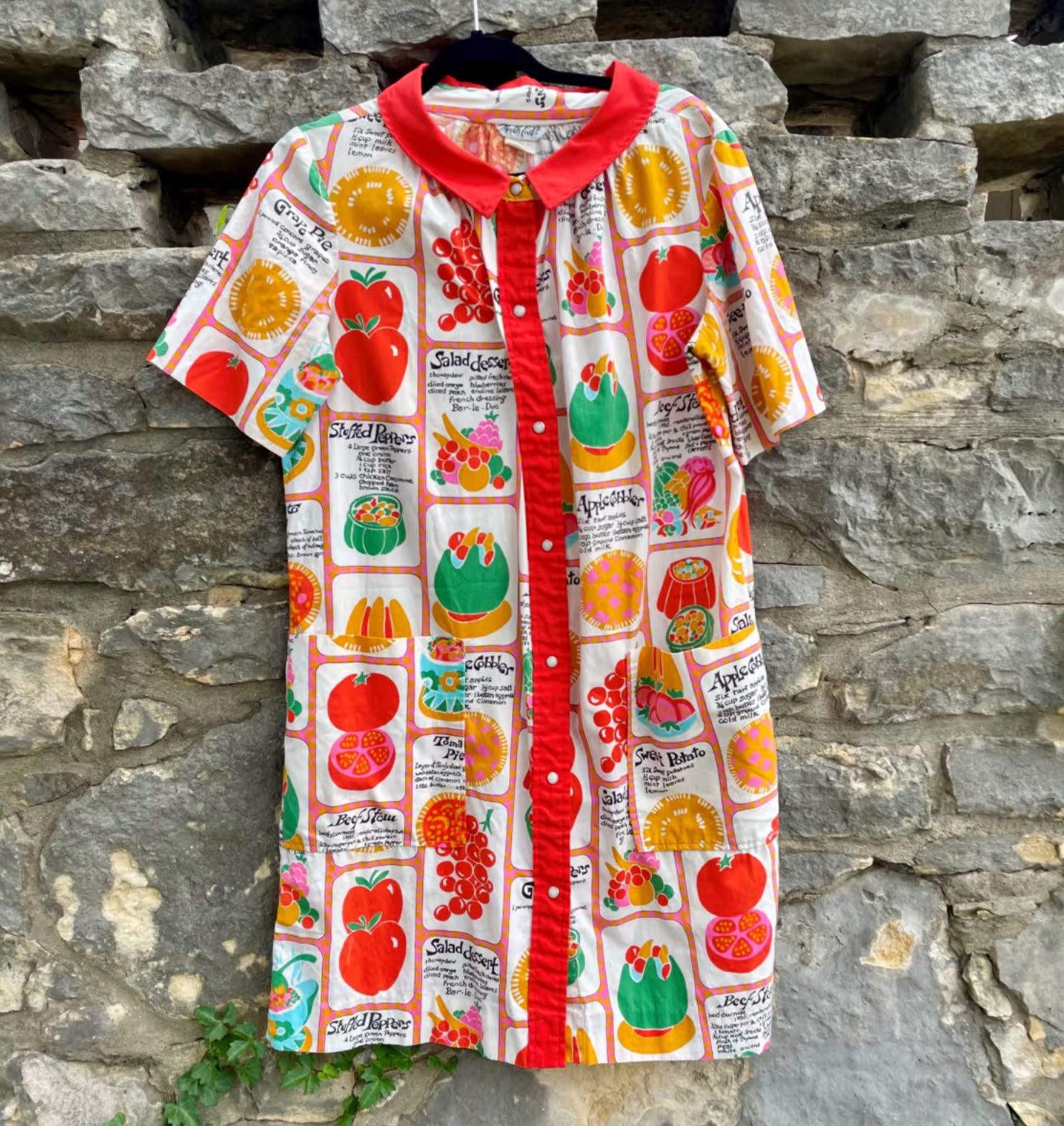
The vintage dress shown above has lots of recipes printed on it. Here’s a great article by a woman who bought the dress and then tried a bunch of those recipes. If I were the kind of person who bought vintage dresses, this is exactly the article I would have written! (From Trish Clark)
Also wish I’d thought of doing a story on the old analog buzzer/intercom systems found in so many NYC buildings.
New York commuters in the 1940s left some pretty odd things on the subway, including lots of dentures. (From Brian Helfrich)
With America’s 250th birthday fast approaching, here’s a look back at all sorts of bicentennial kitsch that flooded the market in 1976.
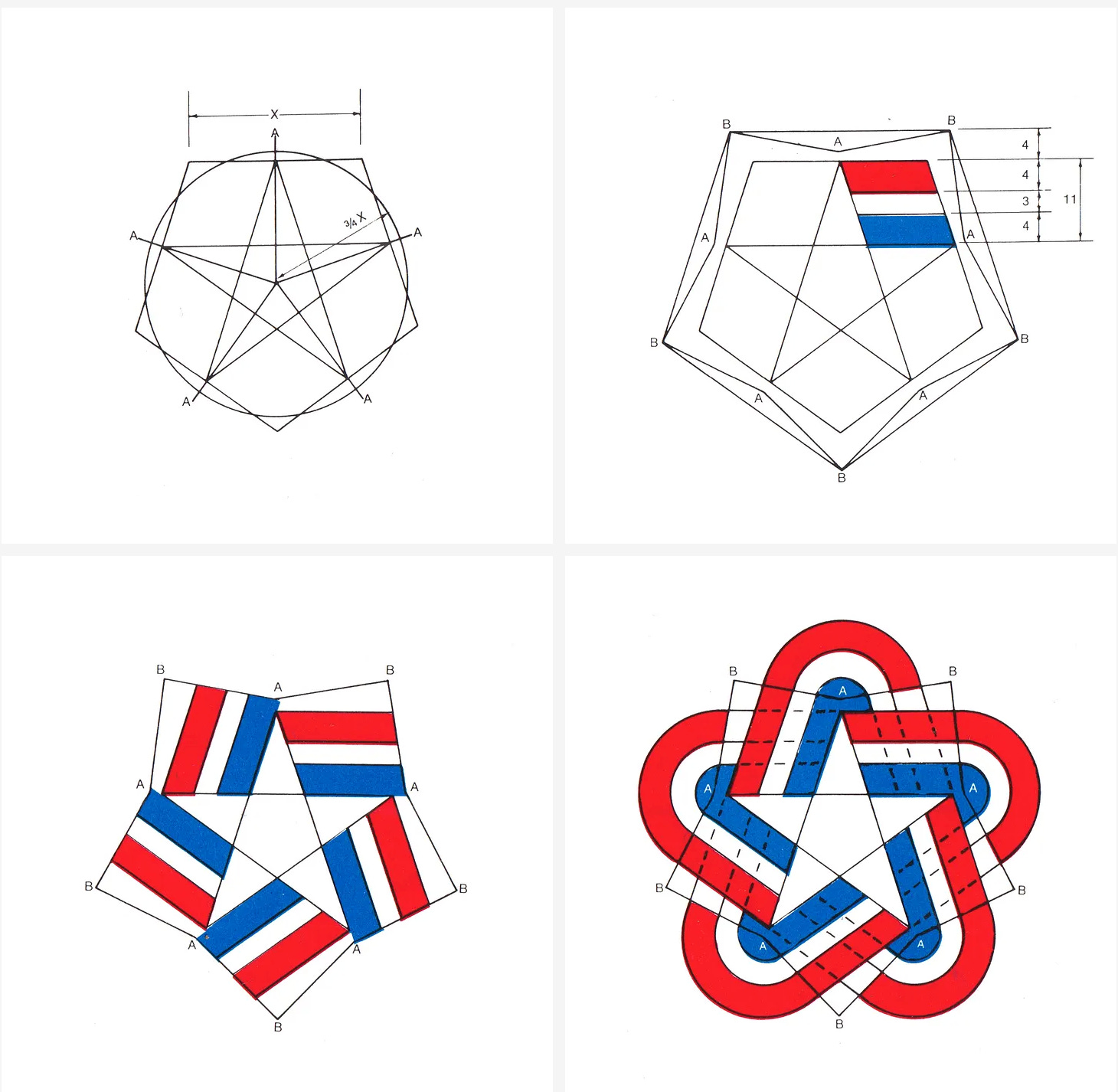
In a related item, here’s the backstory on the bicentennial logo (from reader Salvador):
If you enjoyed our recent discussions of phillumeny, you’ll probably like this archive of matchbox label designs. (From Mark Hurst)
Here’s a brilliantly niche-specific assessment of Penguin Books’ green-themed crime paperback cover designs from the 1960s. (From John Darnielle)
A Philadelphia artist is making a replica of the World Cup championship trophy out of fingernail and toenail clippings (and needs you to donate yours or he won’t have enough!).
This is pretty awesome: NASA has a web page that lets you spell out your name (or I guess anything else) in satellite imagery. (From Rob Walker)
Paul Lukas has been obsessing over the inconspicuous for most of his life, and has been writing about those obsessions for more than 30 years. You can contact him here.
I feel the overwhelm of high volume ownership so this is fascinating. This article has an interesting take on it as well plus of a UK TV show https://theledgebeyondtheedge.substack.com/p/spring-clean
Fascinating. I have become overwhelmed by the amount of stuff I’ve accumulated over the years and have a compulsive need to purge anything that doesn’t have some intrinsic psychological or artistic value. But how to make those decisions? None of them will be the least bit objective.