


Note: This post is not paywalled. It includes some video footage that’s important to the story, so I recommend that you read the web version, not the emailed version. Enjoy! — Paul
A few months ago I wrote about how I went to Manhattan’s Garment District to take a tour of America’s last remaining fabric flower manufacturer. I recently returned to that neighborhood to tour another super-specialized fabric operation: Tom’s Sons International Pleating, which creates pleated fabric for some of the world’s top apparel brands, including Calvin Klein, Ralph Lauren, Oscar de la Renta, and many more.
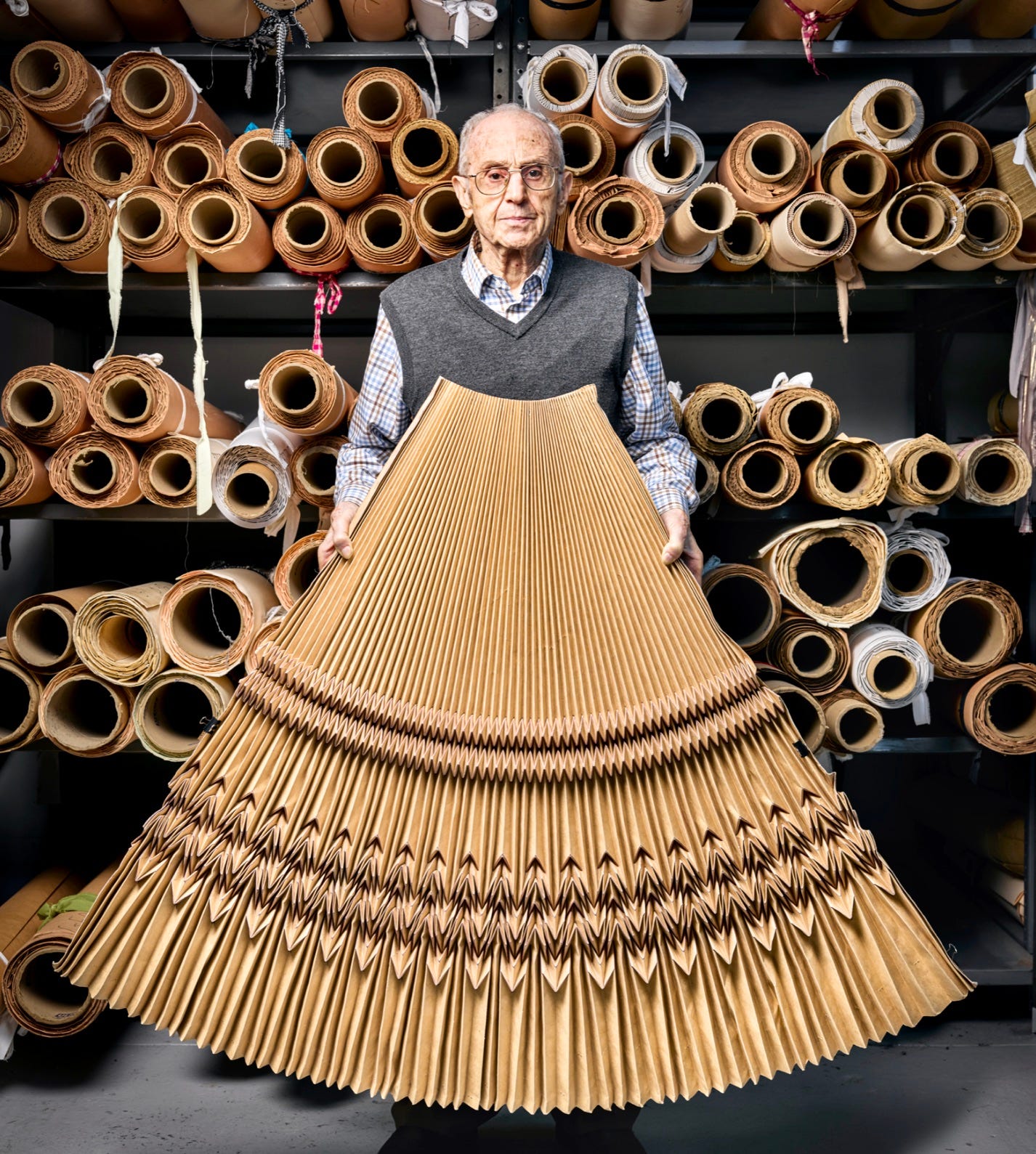
I first heard of Tom’s Sons a few months ago, when I checked out a sensational exhibit of photos shot in factories, called “Made in America” (still up through late September at the Cooper Hewitt national design museum in Manhattan — highly recommended). It included a photo of Tom’s Sons founder Leon Kalajian holding a huge cardboard pleating mold (see above). Obviously, it’s a gorgeous photo, but it also got me thinking. Pleating — that is, the systematic folding of fabric — barely exists in menswear, so I’d never given much thought to how it’s created. Maybe with an iron..? In any case, I definitely didn’t realize it was done with cardboard molds! And the mold looked like a piece of art in its own right, like Ruth Asawa’s folded paper sculptures.
I was intrigued, so I made a note and later looked up the Tom’s Sons website, whose home page features another impressive photo of Leon, this time apparently removing pleated fabric from that same mold:
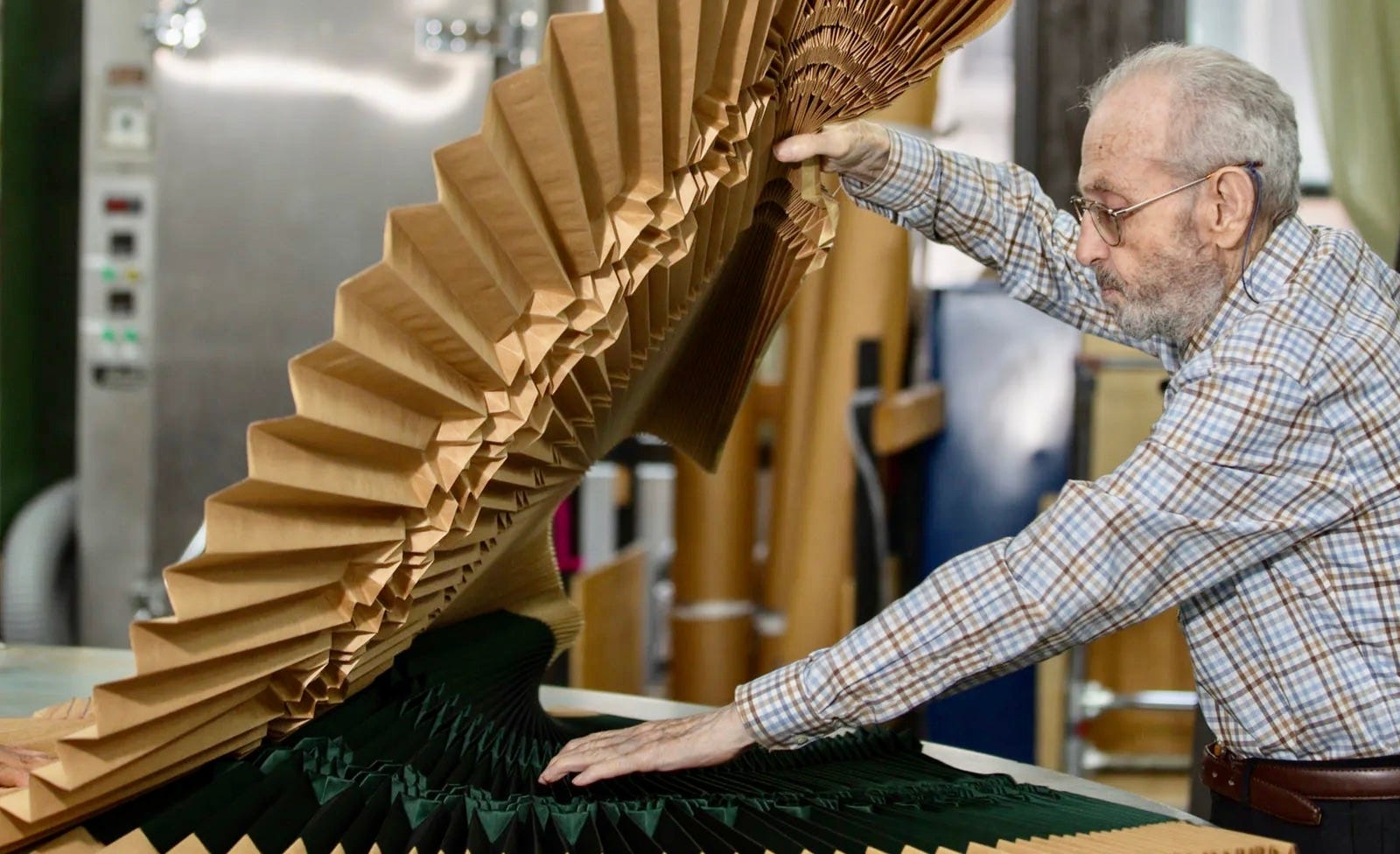
Now I was really intrigued. So when I saw that Tom’s Sons (the name refers to Leon’s father, Thomas) was offering a June tour of their Manhattan facility, I tried to sign up for it. Unfortunately, it was already sold out, so I contacted Tom’s Sons and asked if they could squeeze in one more person. They said no, but after some haggling and cajoling (read: I showed them my article about the fabric flower tour), they agreed to let me come on a different day for a separate visit by myself, which I figured was even better than being part of a big group.
So with a photographer friend in tow, I recently paid a visit to Tom’s Sons, where I learned that Leon Kalajian died in 2023 (there’s a nice obituary here). The business is run these days by his son George Kalajian, who greeted us while wearing a vest with, appropriately, an elaborately pleated back.
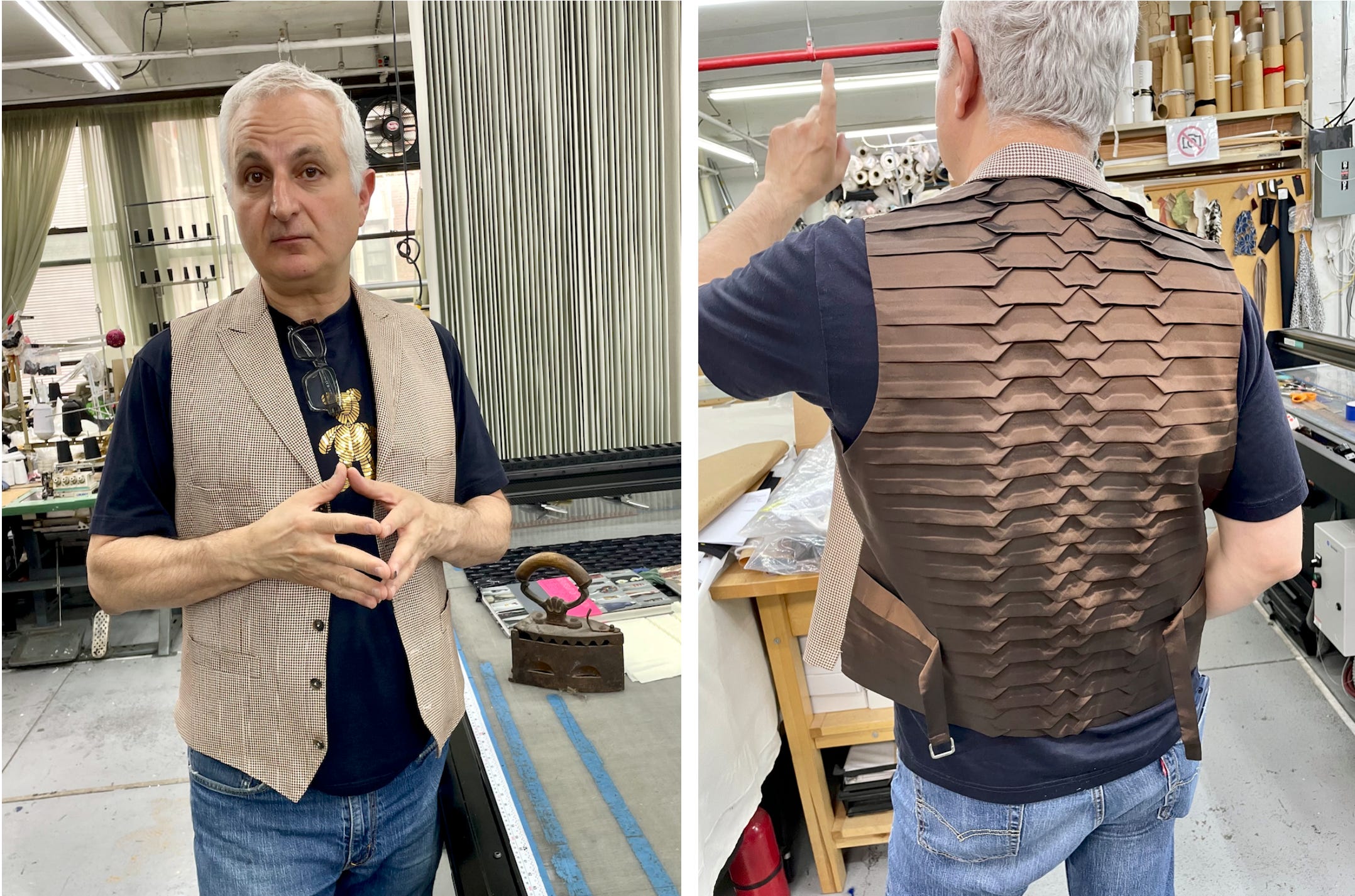
It soon became apparent that George is a very special character. At heart, he’s a master artisan who works with his hands, but he’s also an engineer, a designer, a historian, a writer, a savvy businessman, a philanthropic do-gooder, and, as we quickly learned, an extremely gracious host. He explained that his family specialized in pleating for several generations in their native Lebanon. But after the Lebanese Civil War broke out in 1975, Leon took his wife and sons — including a very young George — to New York, where he established a pleating-centric apparel brand called Pierre Labiche. (The brand’s namesake, like many fashion brand identities, was fictitious. The product line’s actual designer was Leon.)
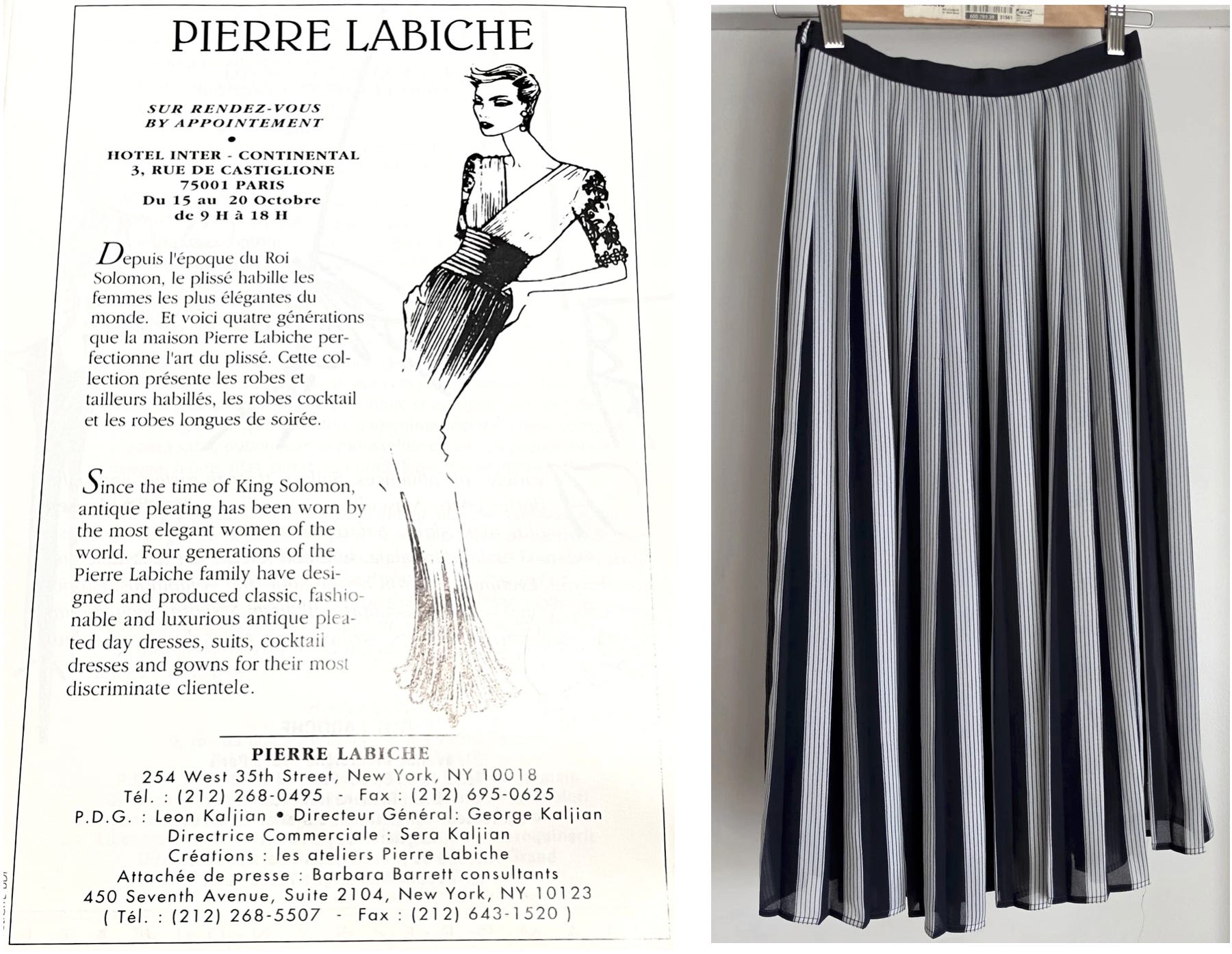
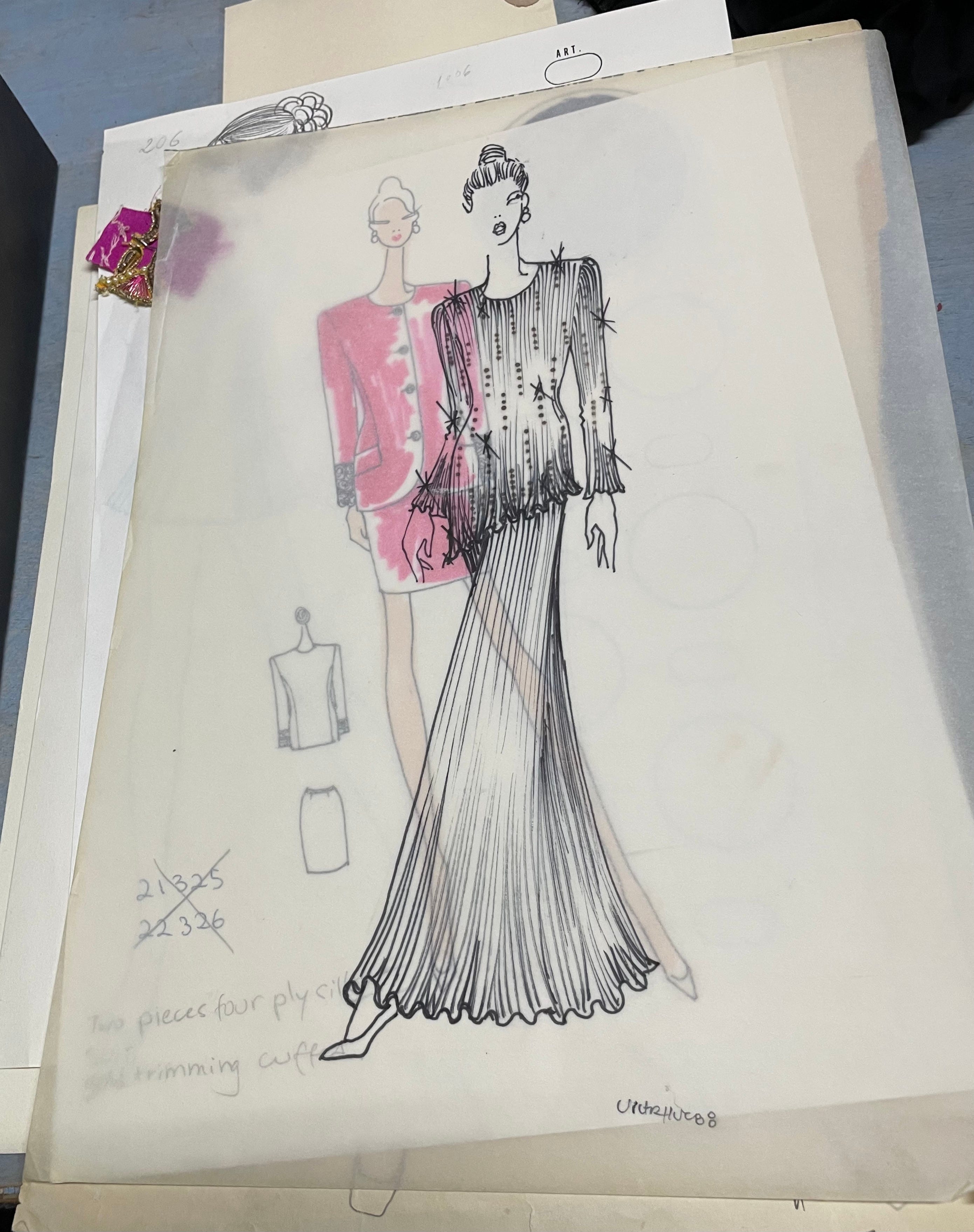
By now you may be wondering, “What’s the big deal about pleating?” That’s understandable if you’re a guy, because there’s a good chance that the only pleats you routinely encounter are on the front of your pants, the back of your shirt, and your sleeve cuffs. Those pleats are fairly minor and extremely localized, and as such are all created as part of the garment’s sewing process. Or to put it another way, they are pleats, but they are not pleating.


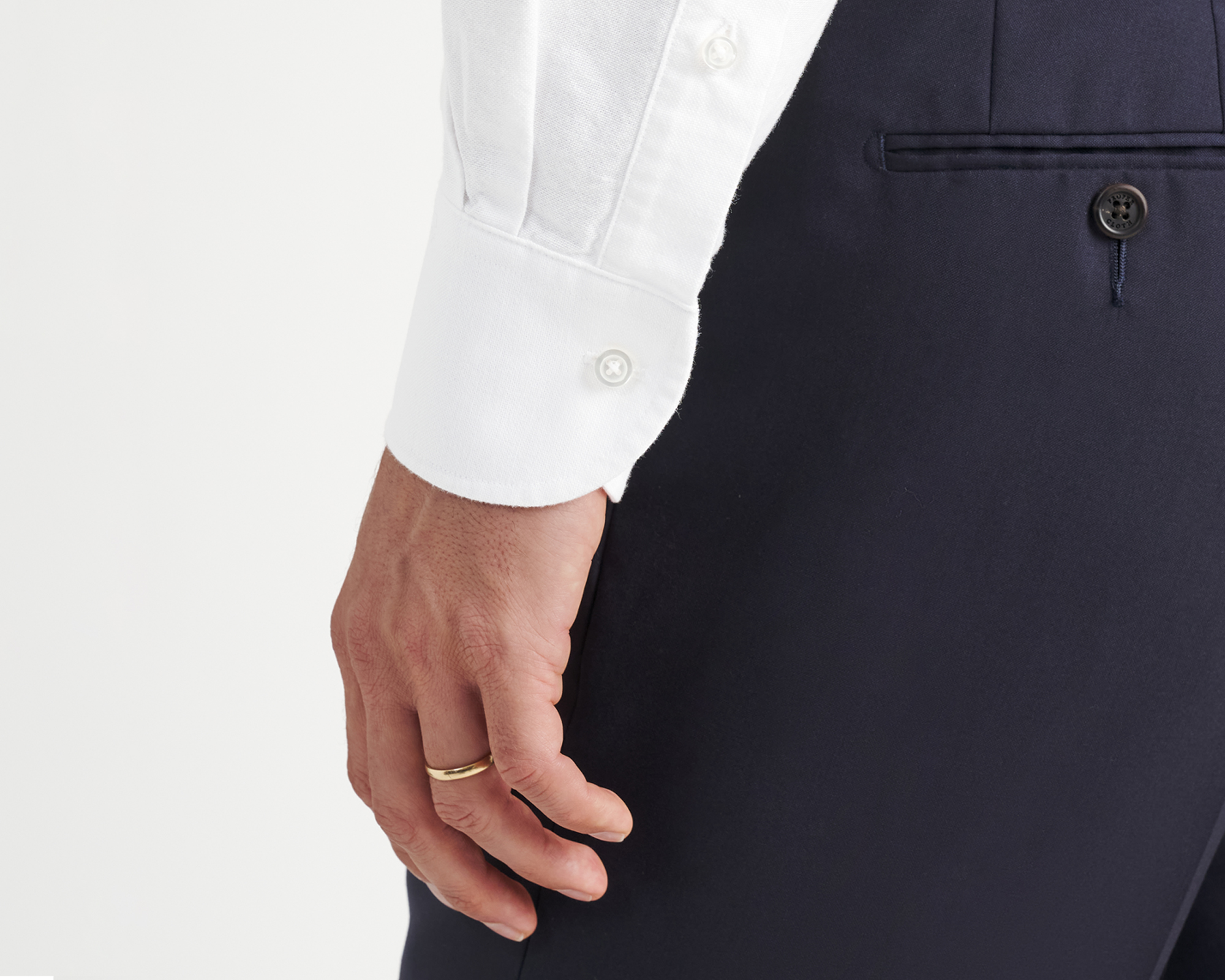
Womenswear, by contrast, often involves fully pleated garments that shimmer, undulate, and sway as they move. A good example is the “Angel Dress” conceived by the child prodigy couture designer Max Alexander, who worked with George to create that dress, as seen in this video (which originally appeared on Instagram, but I shot a video of the video so I could embed it here):
Pleats like those are not created as the garment is being sewn together. Instead, the fabric is pleated before the garment is sewn. Apparel companies don’t do that themselves; they outsource the work to specialists. That’s pleating — and that’s where Tom’s Sons comes in.
“My father was a pioneer, really a genius,” George told us, describing the company’s work. “He created pleating techniques and innovations that no other company does — things I can’t let you photograph, things we don’t even let some of our employees see.”
I was curious about the cardboard molds, which George was willing to let me photograph. Here’s a video clip of him explaining how the fabric is put in a mold to create a pleated pattern (you may have to turn up the volume a bit to hear him clearly), followed by two photos that provide a closer look at the mold he’s handling in the video:
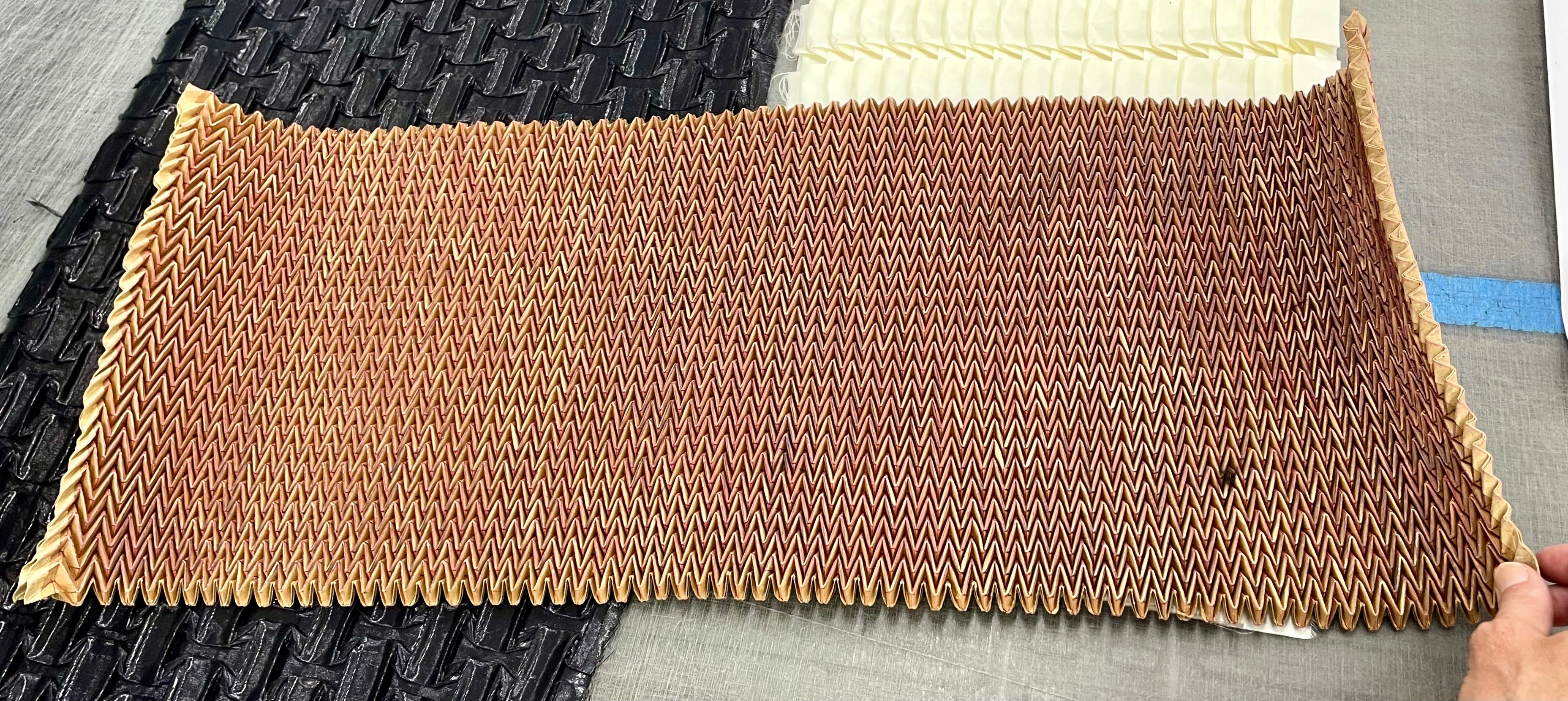
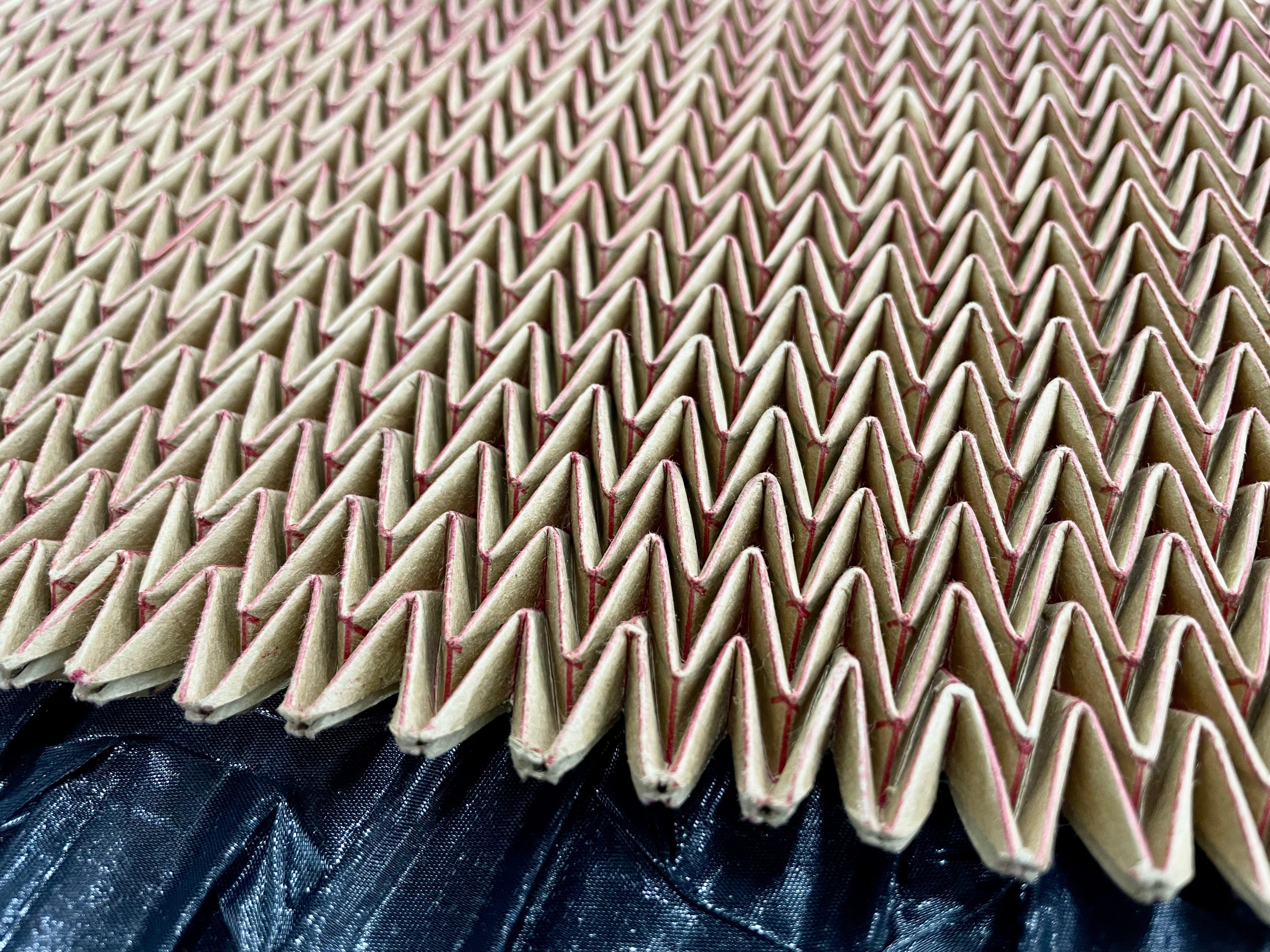
Isn’t that amazing? So geometric! I asked George who produces the molds and he said, “We make them ourselves.” When I asked how, he smiled, shook his head, and said that was a trade secret.
In a different part of the factory, we saw another mold, called a sunburst mold. It was large and semicircular, like a giant version of an old-fashioned handheld fan. The bottom part had been spread out on a work table, where a semicircle of white fabric had been laid over it.
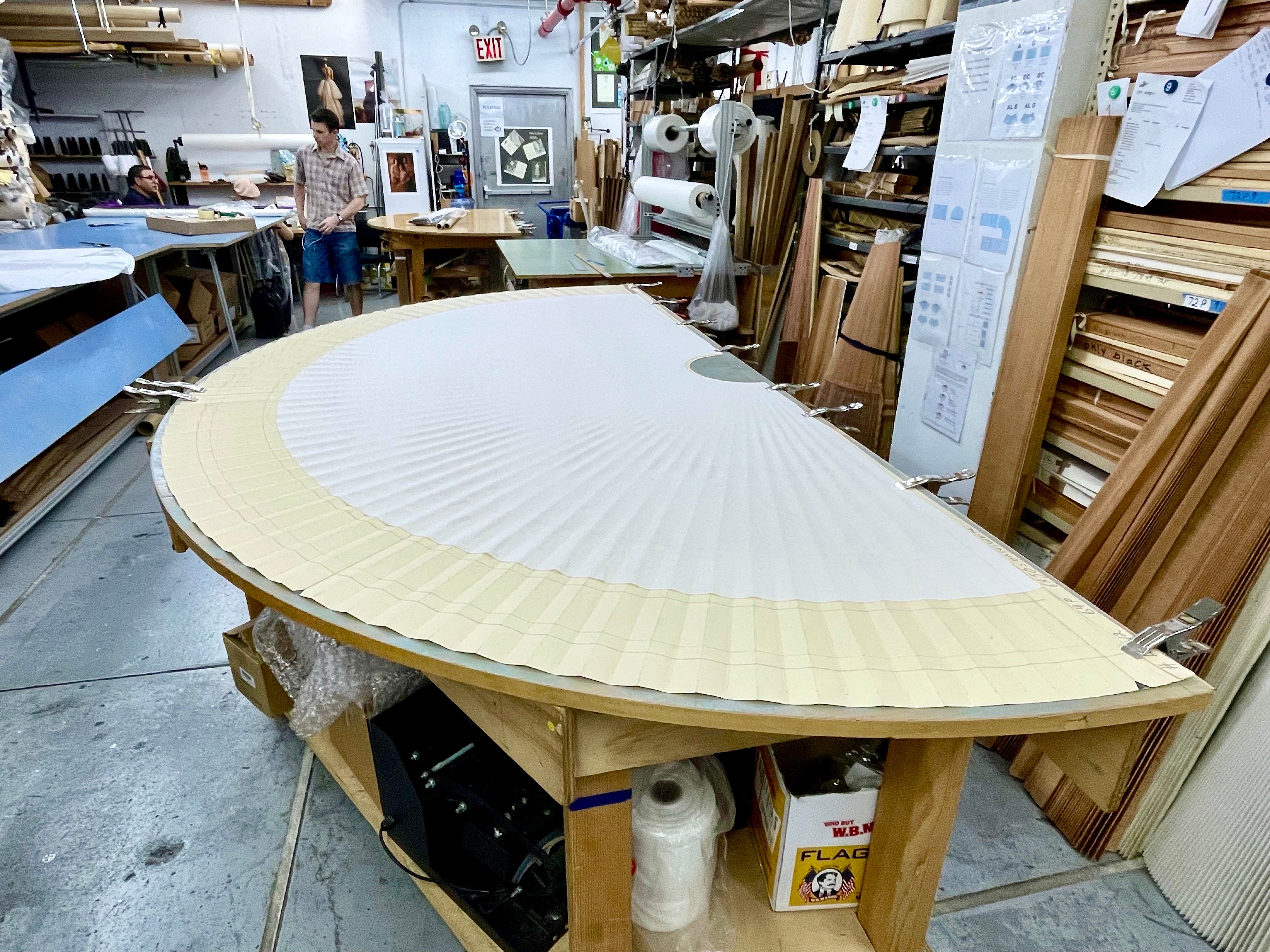
We watched as two employees put the top piece of the mold over the fabric. Then they carefully folded up the mold, with the fabric still inside — closing the giant fan, so to speak.
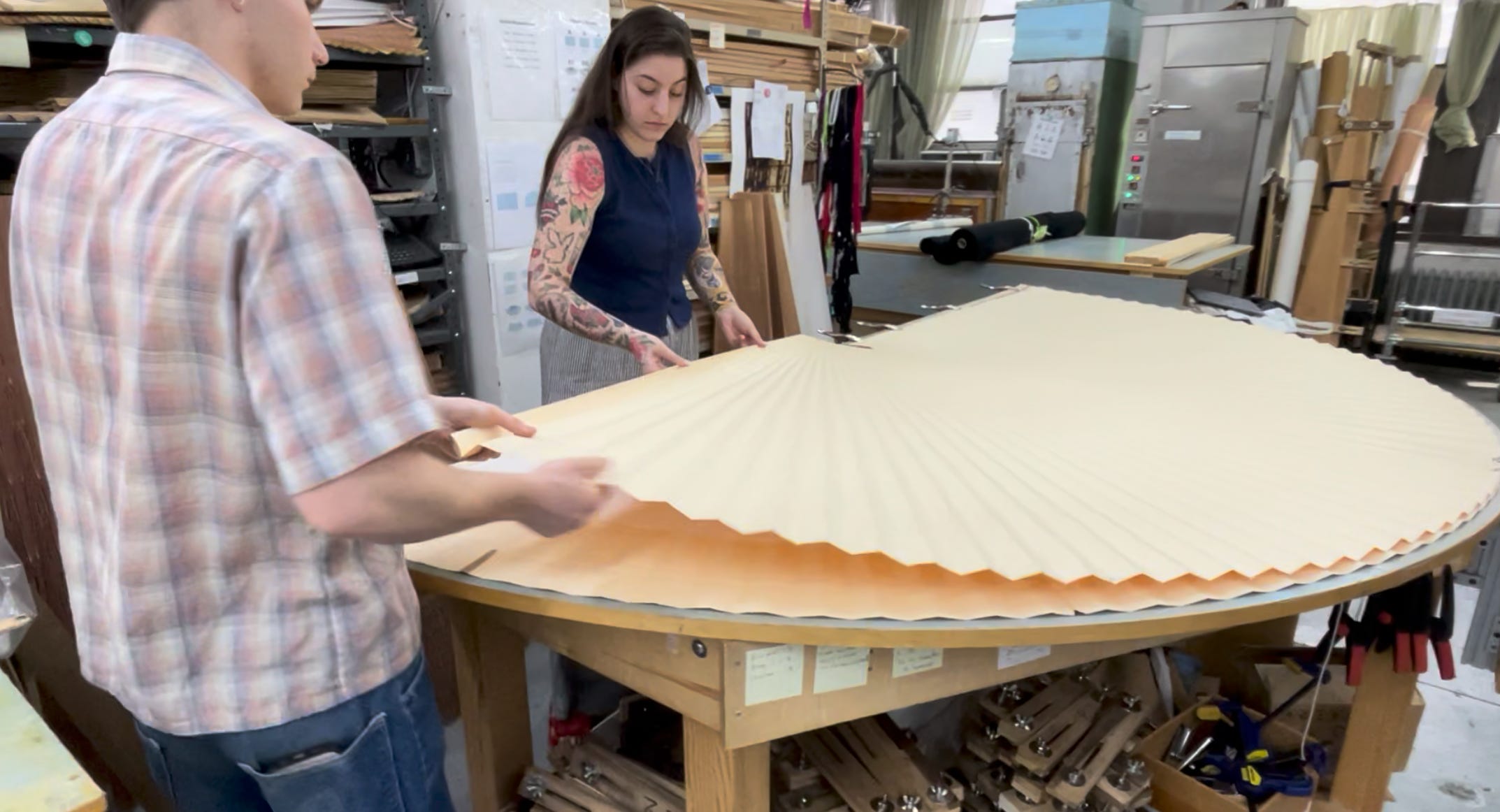
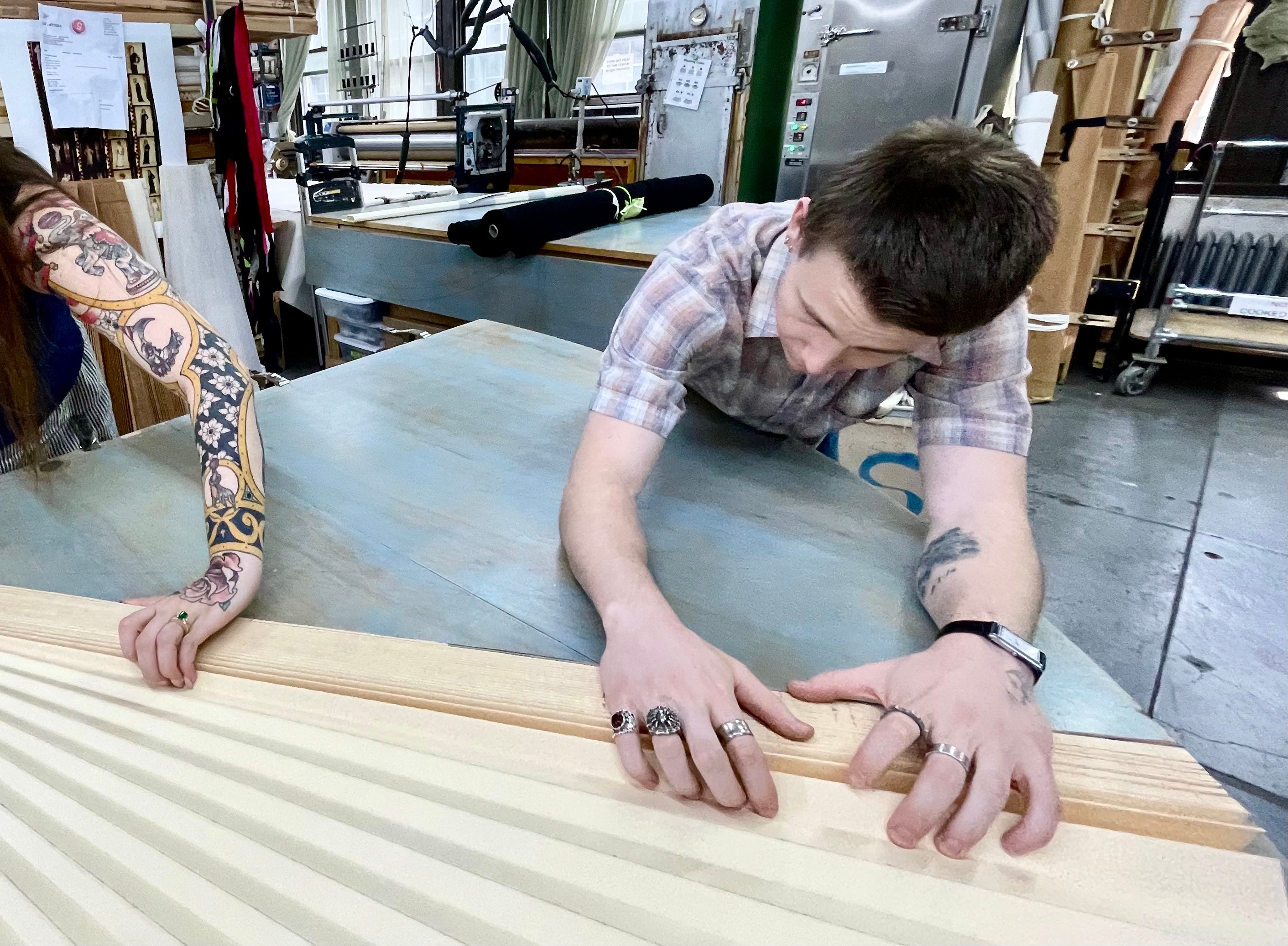
The compressed mold — with the fabric still sandwiched between the top and bottom layers — would then be, as George likes to say, “cooked in the Instant Pot,” which is an industrial-grade steam cabinet that makes the pleats permanent. George would not discuss any details of that process, nor would he let me photograph the steamer.
The sheer number and variety of cardboard molds on hand was mind-blowing. They seemed to be everywhere — on shelves, peeking out of cabinets, and so on. Here are some photos I took:
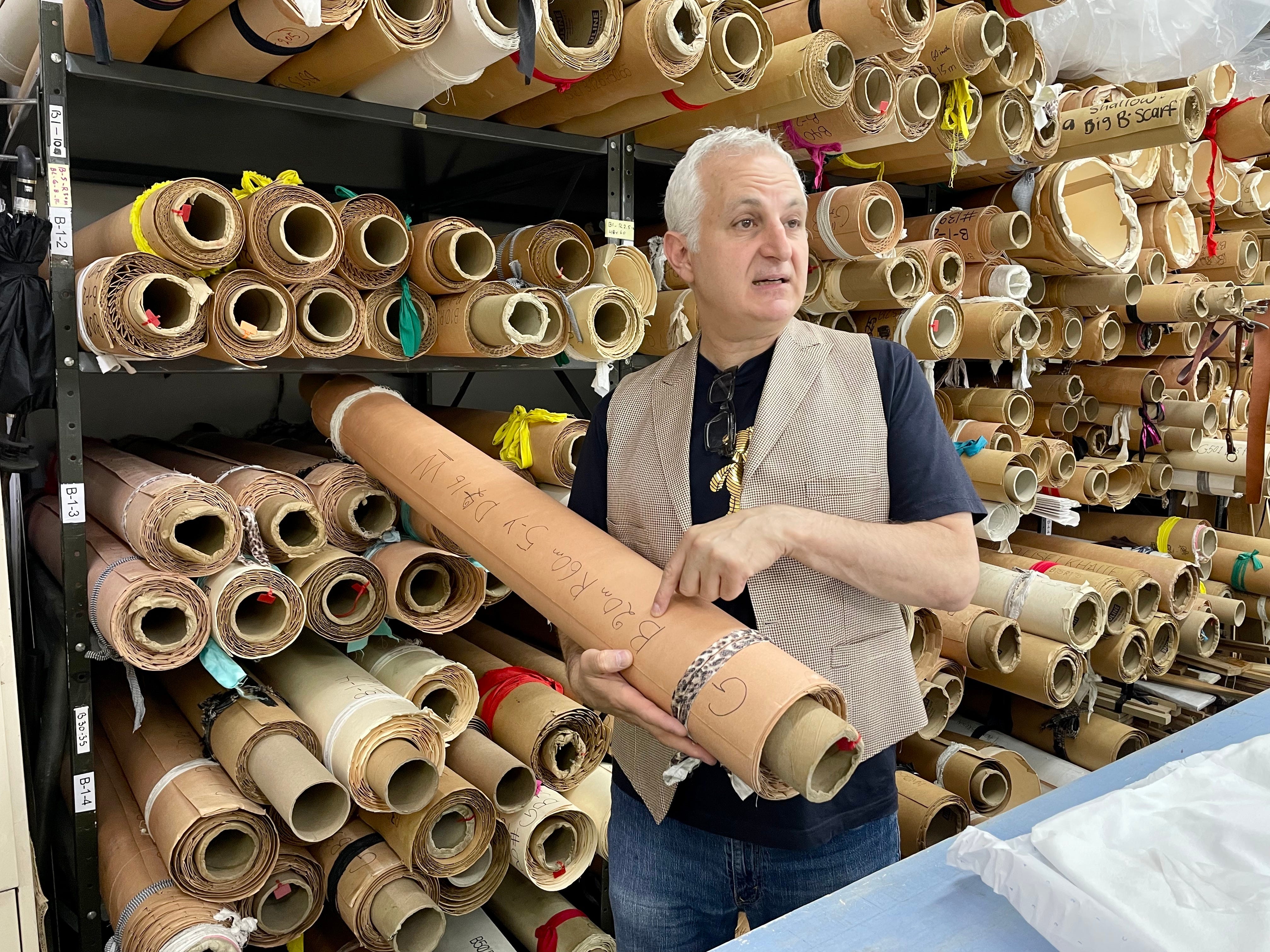
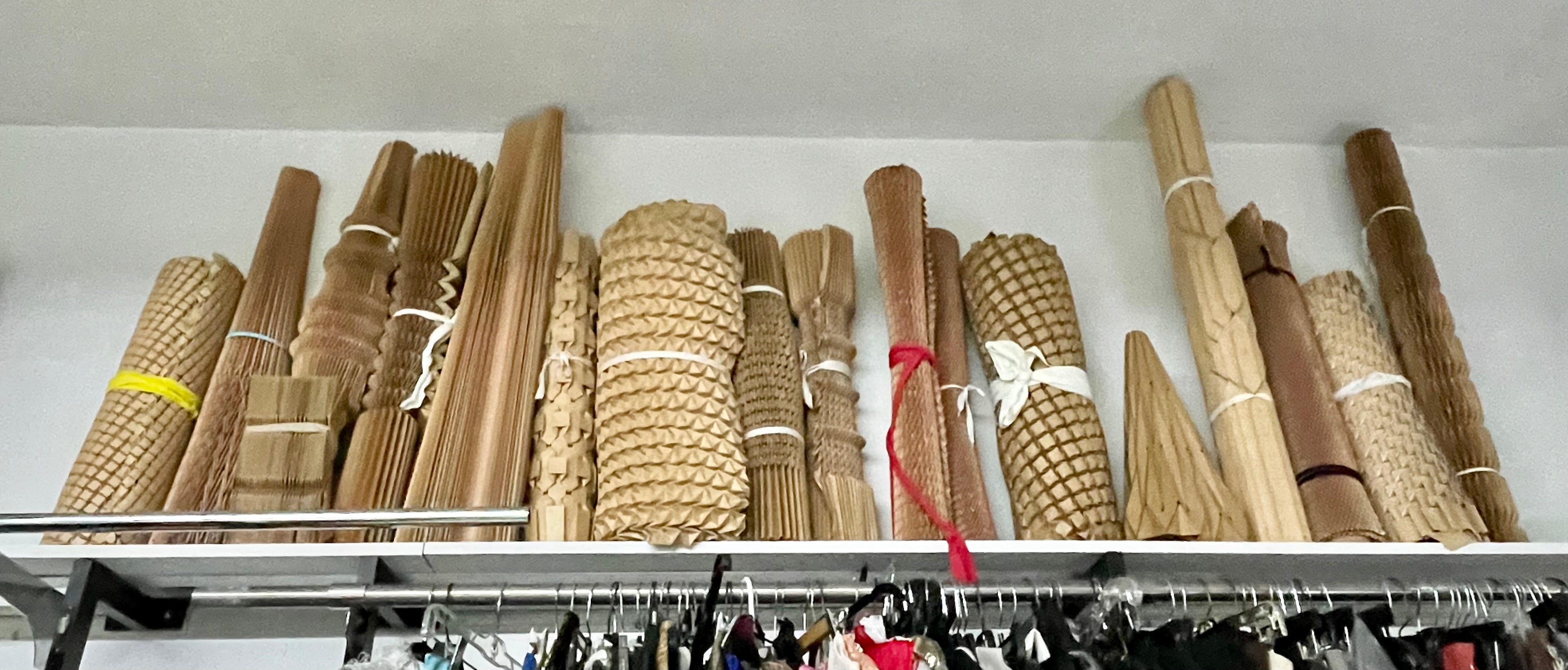
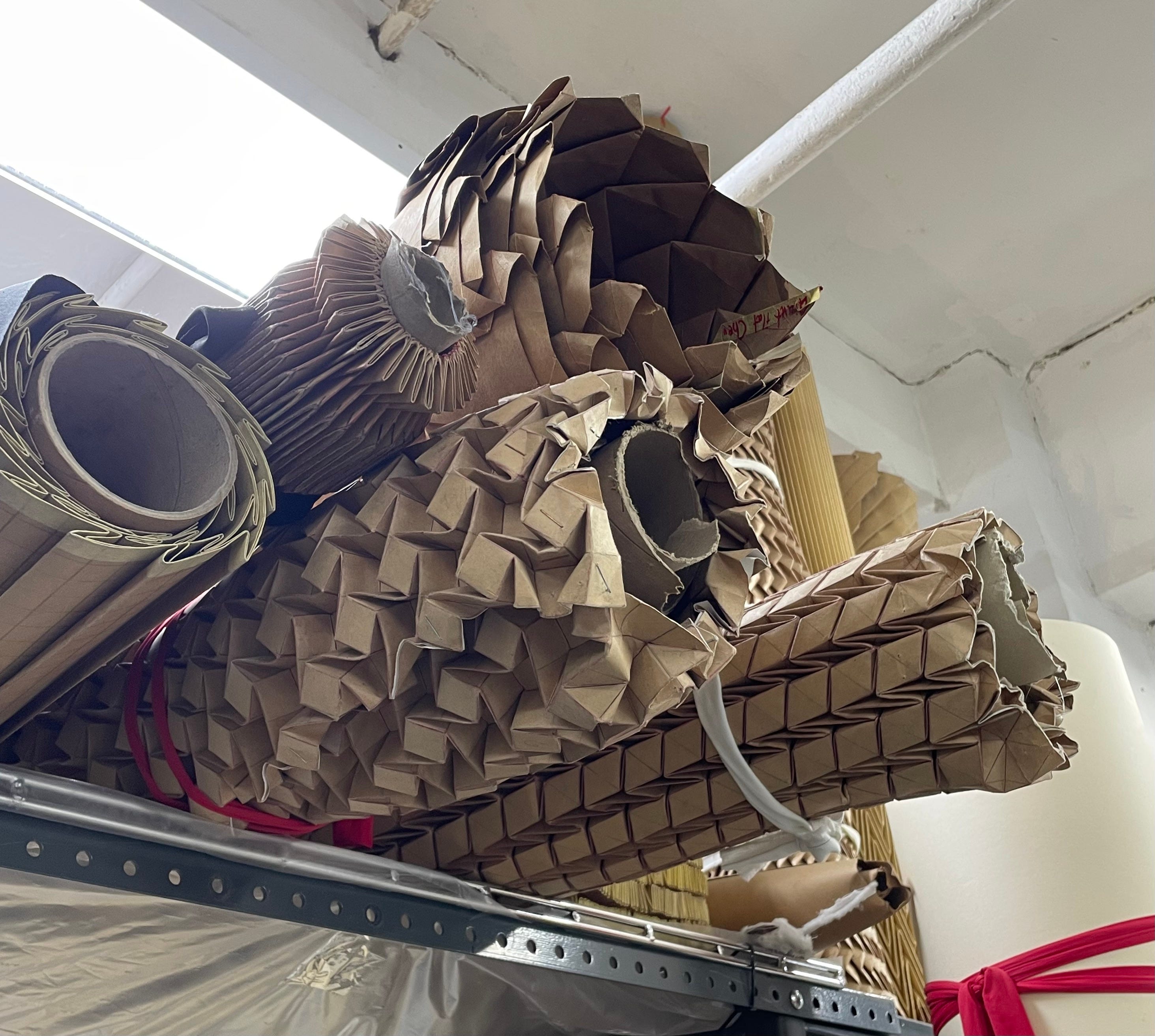
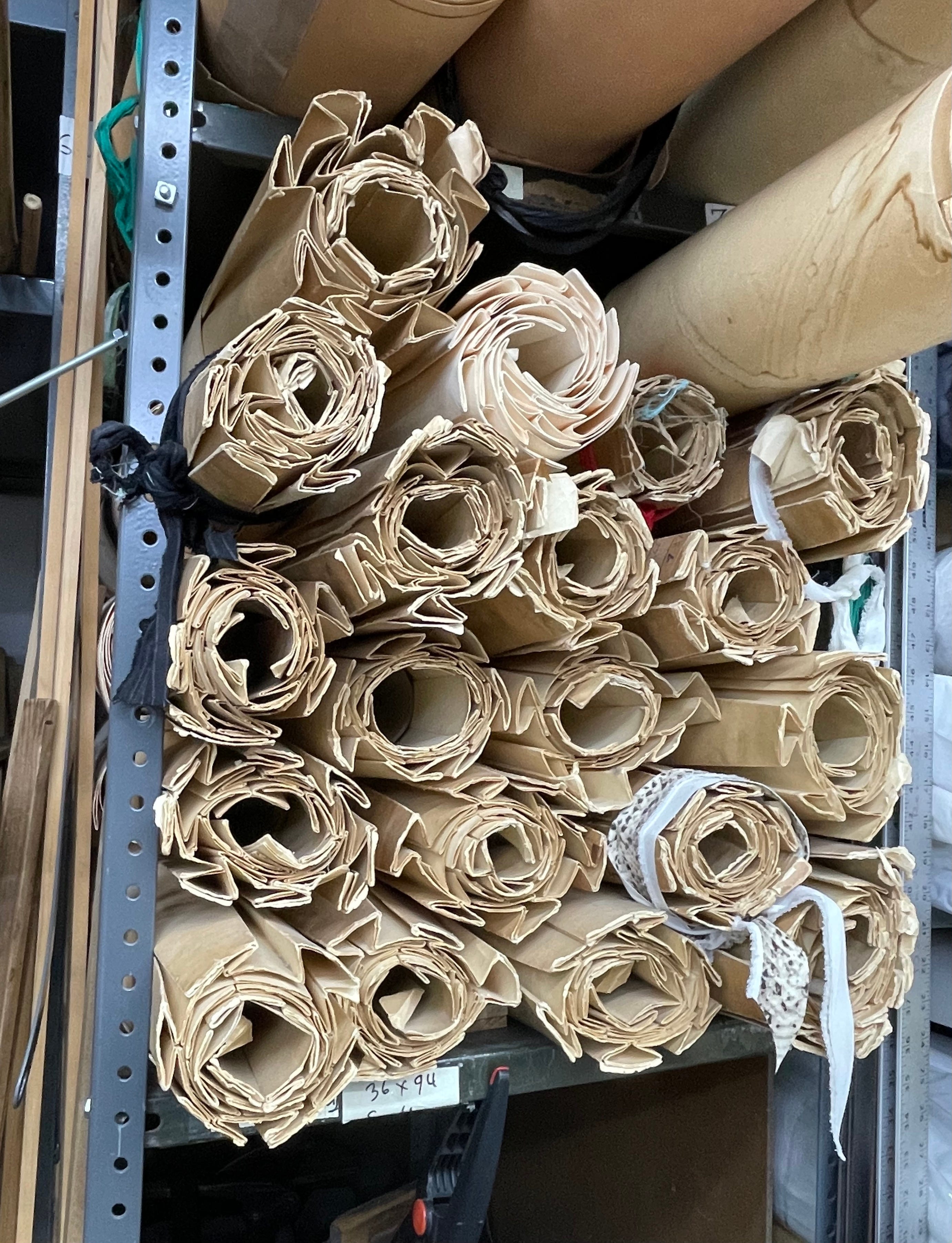
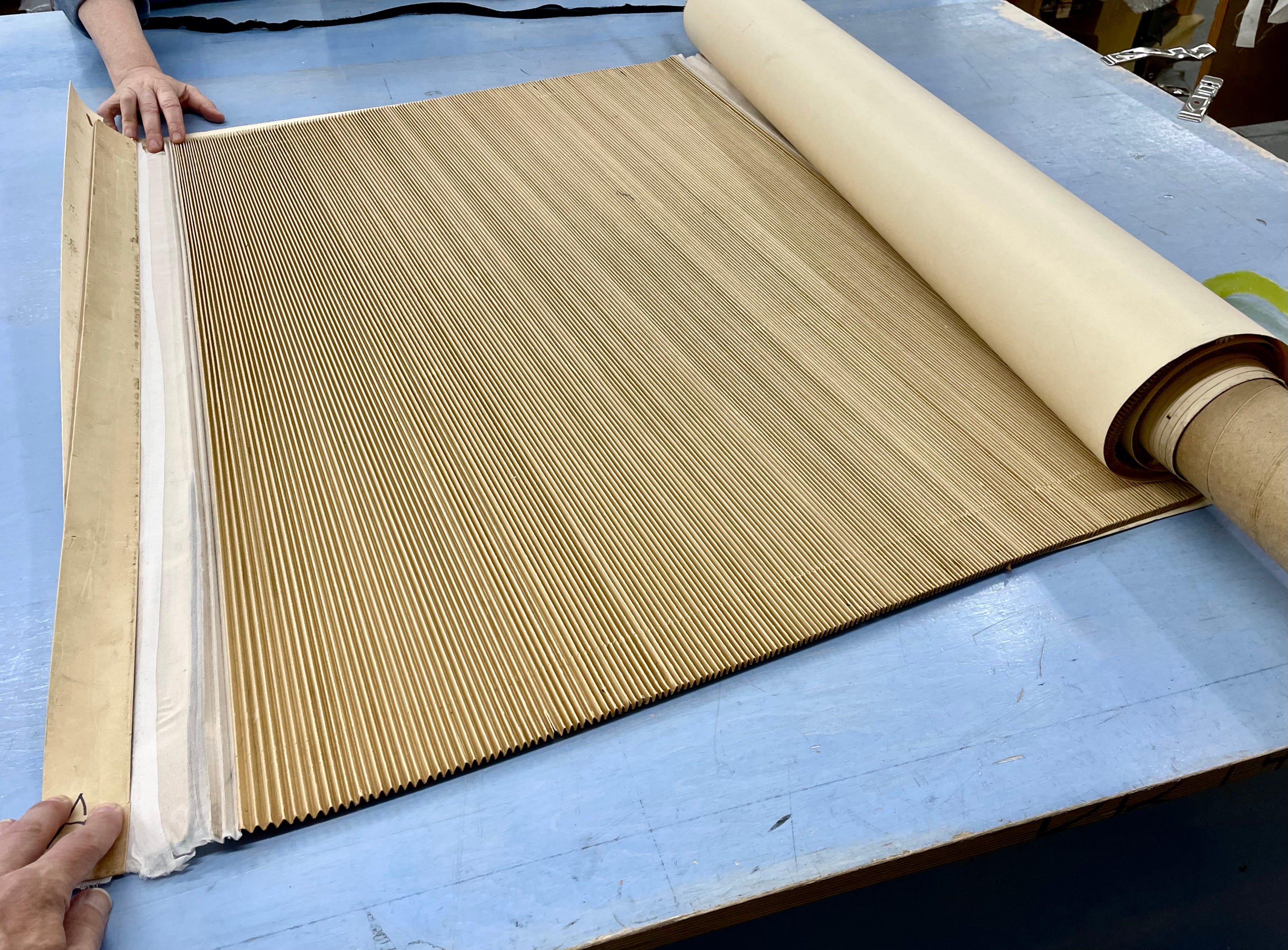
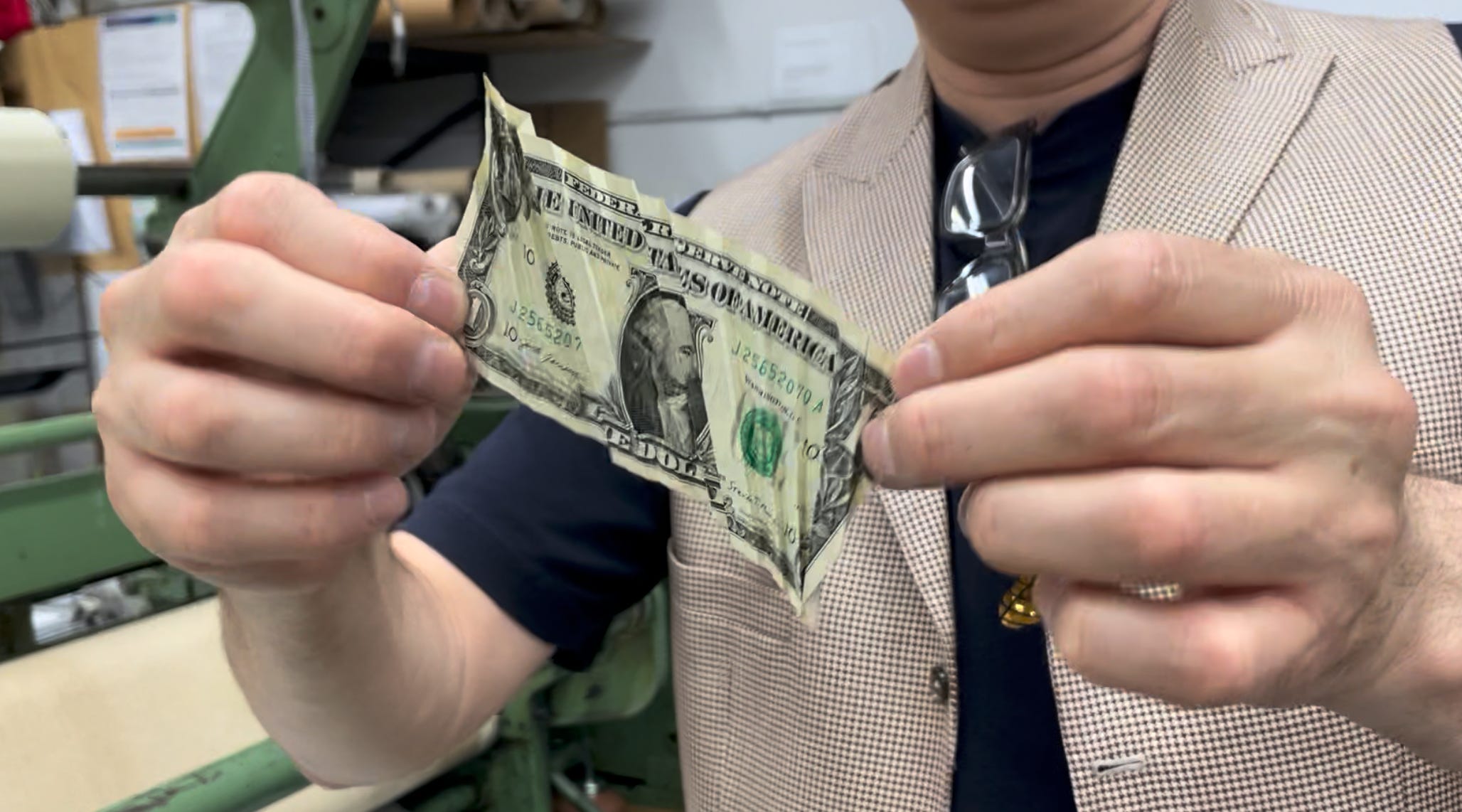
George explained that the pleats made by the mold in that last photo are the smallest ones that can be mold-made. For even smaller pleats, the factory has a special machine, which George demonstrated for us by running a dollar bill through it. I got the impression that this is one of his favorite party tricks for visitors.
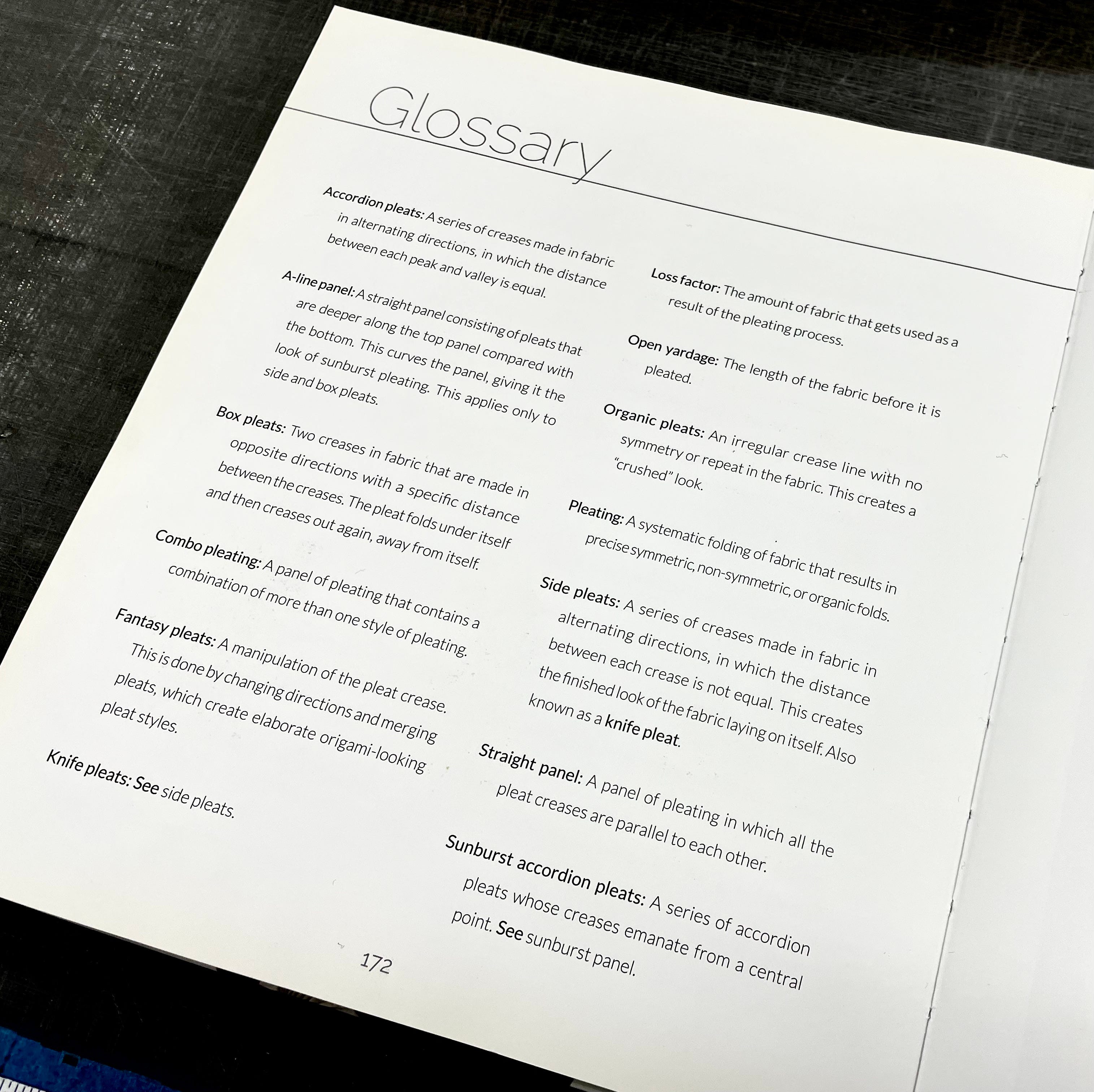
George’s knowledge of all this stuff is so encyclopedic, you might say he wrote the book on pleating. And he did — literally: He and Leon co-authored Pleating: Fundamentals for Fashion Design, a 2017 book that took about four years to put together. It’s considered the definitive reference for commercial pleating.
But George’s authoritative knowledge is leavened by endearing bits of playfulness. Photos on the internet show him wearing a T-shirt that reads “For Pleat’s Sake” (a phrase I stole for the headline of this article); one of his websites prominently states, “MUST LOVE PLEATS”; and his email signature features a simple but clever combination of forward slashes and backslashes to create a pleating symbol.
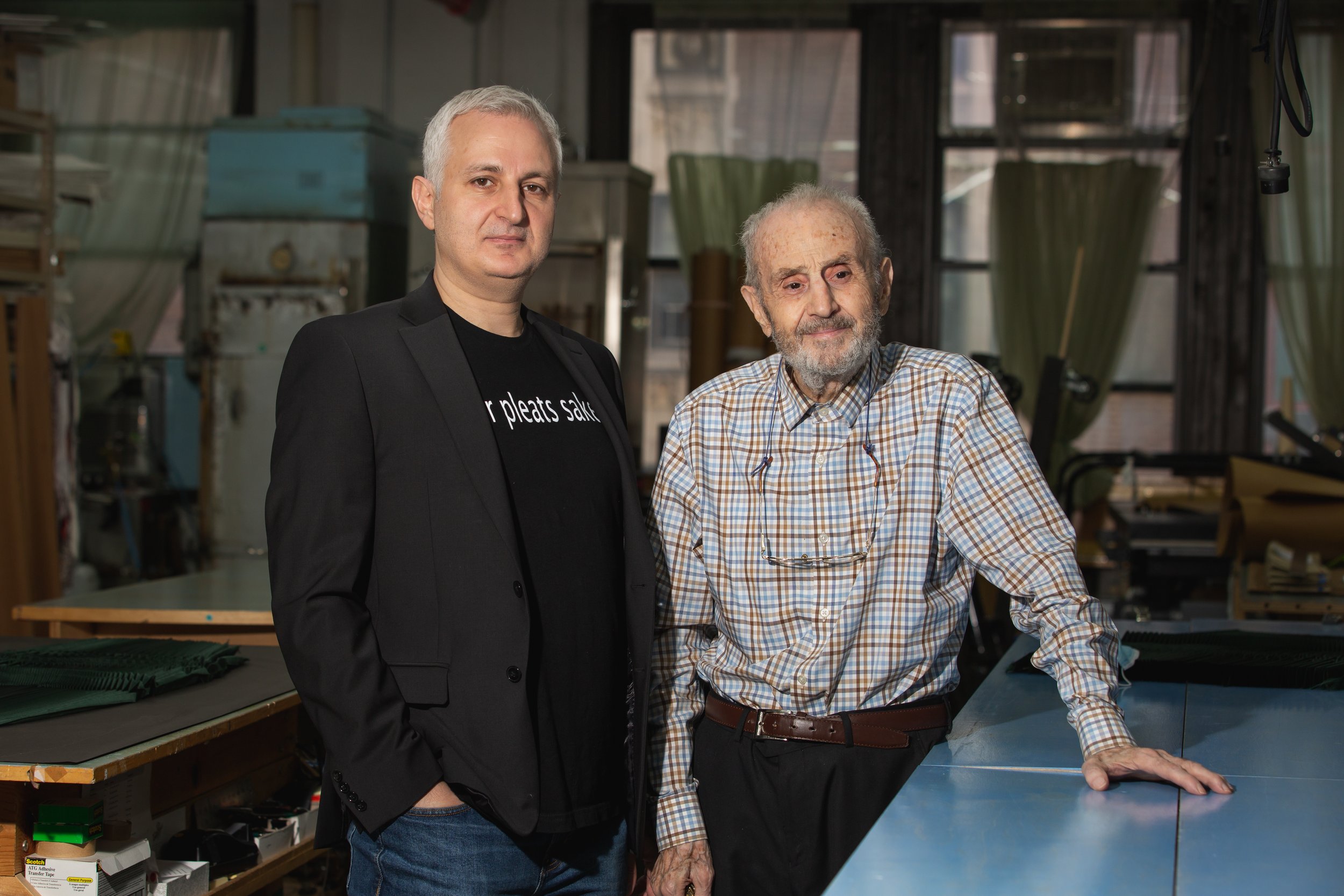

George is in his mid-50s — young enough to keep Tom’s Sons going for a while longer, but old enough to be thinking about a succession plan. He takes his family’s textile legacy very seriously, but he doesn’t have kids of his own and his only sibling opted to pursue a different career path, so he’s accepted the reality that the business will probably not remain in the family. He’s considered mentoring an employee to become his protégé but has found it difficult to find the time.
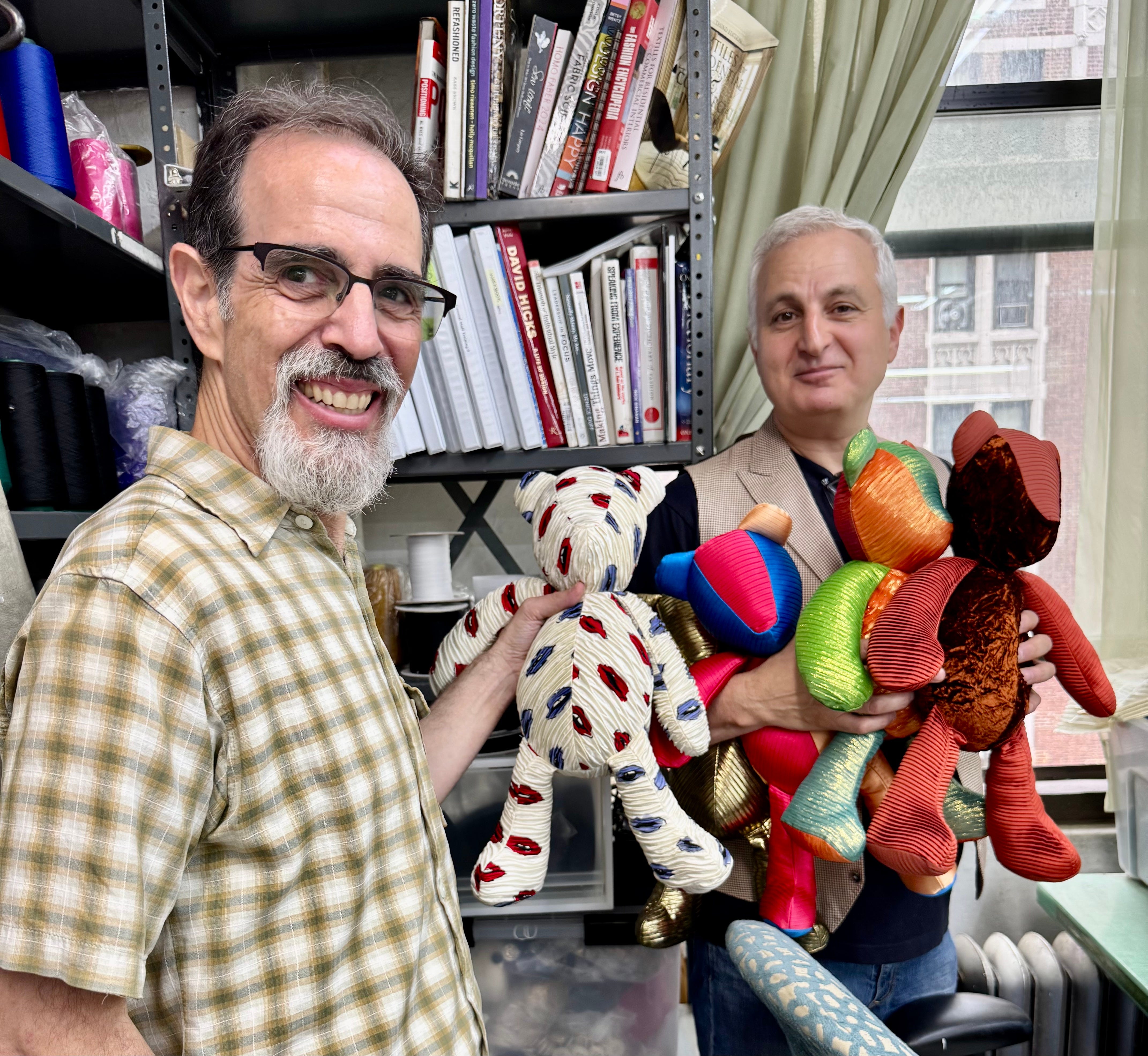
One possible solution is Project Golden Bear, a nonprofit initiative that George launched in 2024. The program allows young people to develop into artisans by apprenticing at Tom’s Sons and using scrap pleated fabric to create teddy bears that will be given to terminally ill children. Ideally, one of the apprentices will fall in love with pleating, stay on as a full-time employee, and, in a best-case scenario, one day take over the company.
But that outcome, if it happens, is still a long way down the road. For now, George is still busy doing contract pleating work for various fashion houses and running Project Golden Bear. He’s also revived his father’s old Pierre Labiche label and is designing all the apparel for that line.
We ended up spending about two and a half hours at Tom’s Sons. Along the way, we met George’s mother (she stops by the factory almost every day) and were invited to join a little going-away party that had been convened to mark an employee’s final day on the job. By the time we left, we felt like honorary members of the family. “Come back anytime,” said George. “Don’t be strangers.”
You can learn more about Tom’s Sons on their website, and there’s also lots of fun stuff on their Instagram page. (George’s handsome greyhound, Rags, who is sometimes at the factory but wasn’t there on the day I visited, is on Instagram too.)
Between the fabric flowers tour in March and now the commercial pleating tour, I feel like I’ve gotten to experience two very specialized and super-inconspicuous manufacturing operations. They say good things come in threes, so here’s hoping that means there’s another esoteric factory tour in my near future.
(Special thanks to Patricia Clark for the teddy bear photo and invaluable editorial feedback.)

Inconspicuous News Roundup

U.S. 20, the longest highway in America, stretches 3,365 miles from Newport, Oregon, to Boston. There are signs at the eastern and western termini, indicating the full distance to the other end of the road. And yes, I enjoy having an excuse to say “termini.” (From Erik Bredberg)
Wegmans appears to have a font-chaos problem. (From Patricia Clark)
Can’t believe I didn’t know until now that there’s an online museum devoted to moist towelettes. (From The Art of Noticing’s Rob Walker)
Number progressions usually run from the smallest number to the largest, so it’s a bit odd that this sign at New York City’s Grand Central Terminal directs travelers to “tracks 21 to 11” (from Ben Wright):

Paul Lukas has been obsessing over the inconspicuous for most of his life, and has been writing about those obsessions for more than 30 years. He also writes Uni Watch, which is sort of like Inconspicuous Consumption for sports. You can contact him here.
OMG I could never visit that Pleating factory! The tactile obsessive in me would be touching every mold and climbing everywhere. This was seriously a white knuckle read for me and my favorite of your visits!
Grand Central's a Terminal, not a station. Tracks end at termini and pass through stations. GCT's tracks are numbered "right to left" when facing the platforms, hence the backward progression on the signage. Why it's right to left...no idea.