
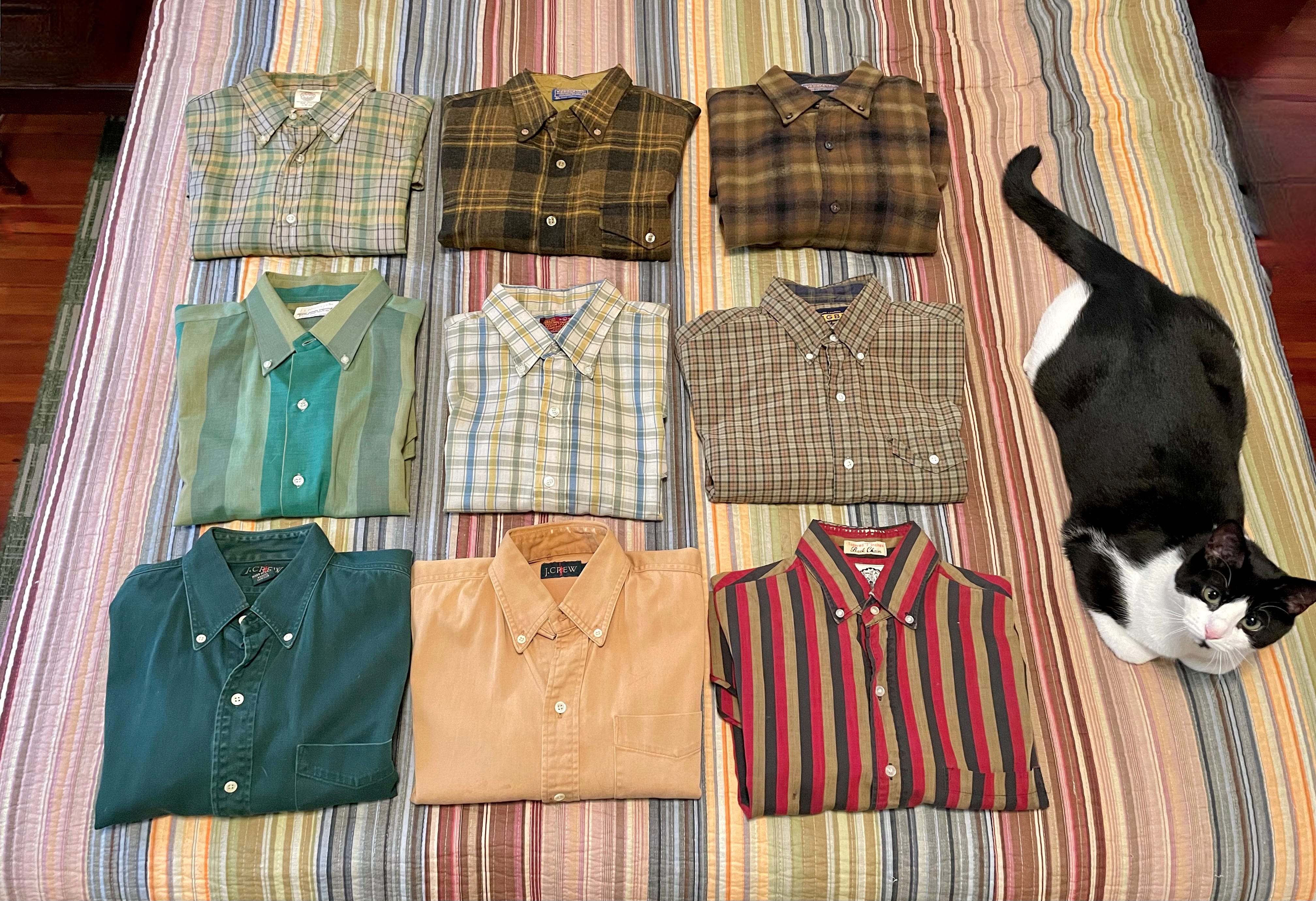
I recently went through my closet and pulled out the nine shirts shown above. As you can see, they all have button-down collars. Can you spot the other design detail that they all share?
That’s actually a trick question, because the detail I’m referring to isn’t visible from the front. Here, let me turn the shirts over so you can take another look:
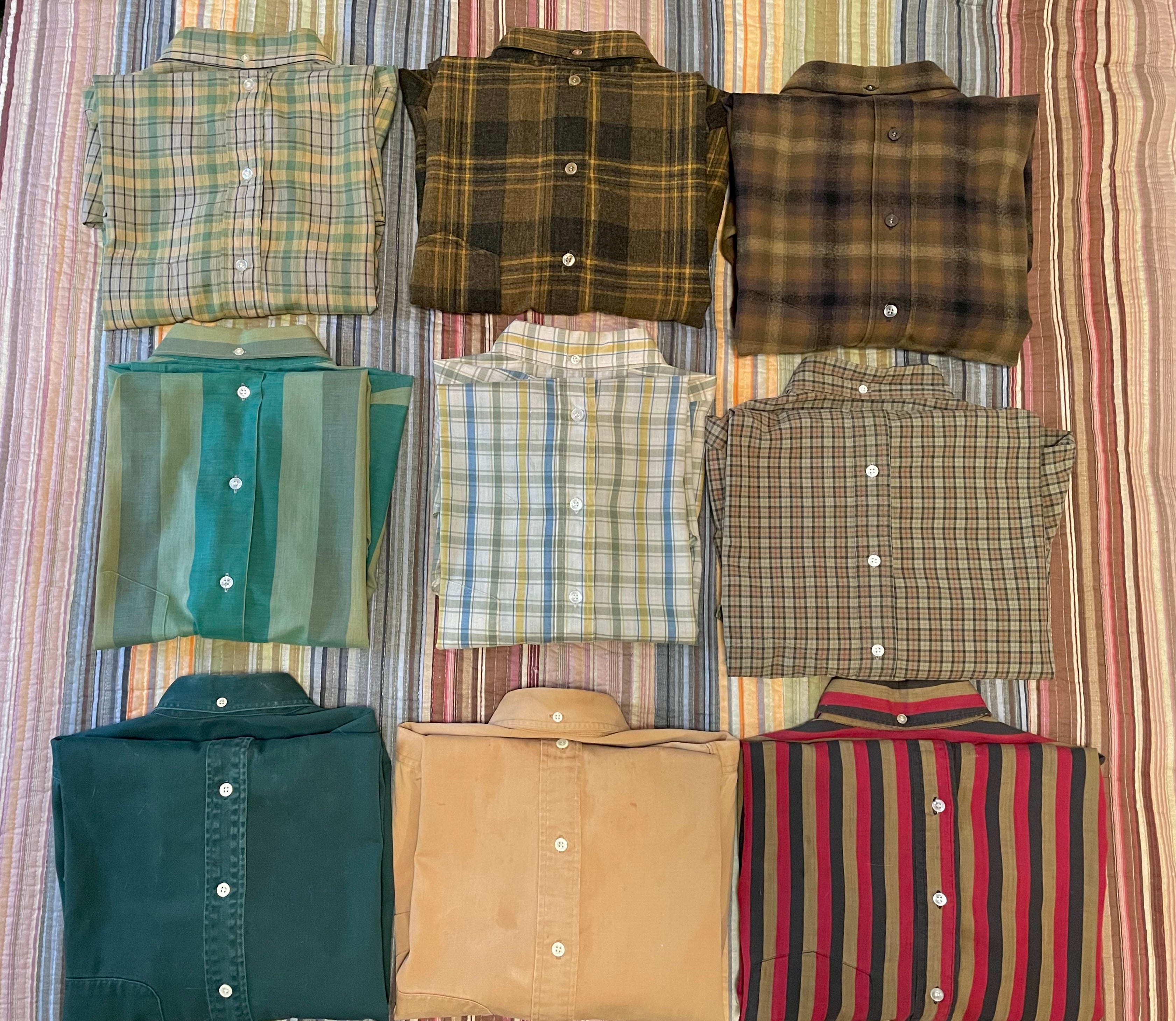
As you can see, each of these shirts has a button on the back of the collar. That’s in addition to the two buttons on the front collar points. In case you’re not familiar with this sartorial detail, here’s a video slideshow that provides a closer look at all nine of the back collar buttons shown above:
I happen to be a big fan of the back collar button. It’s not a make-or-break detail that dictates my purchasing behavior, but it’s a fun little bonus that I’m always happy to encounter, like finding a pea crab in an oyster. Why do I like it so much? Here are some reasons:
The back button’s heyday was the 1950s and ’60s, so it has an old-school retro appeal.
I like knowing that an extra bit of craftsmanship was expended to create the additional buttonhole and button. It’s not exactly a luxe feature, but it nonetheless makes me want to say, “Thank you, Mr. Shirtmaker, for going the extra mile with this added detail!”
I’m a big fan of functional specificity, so of course I like the idea of an extra button in an unexpected spot (even though, as we’ll soon see, its actual functionality is somewhat questionable).
Even when the back button is there, many people either overlook it or don’t really think about it. It is classically, prototypically inconspicuous.
In fact, the back button is so totally in my wheelhouse that I can’t believe I’ve never written about it until now. And it turns out that there’s a lot more ground to cover on this topic than I expected, so let’s get started with the most basic question: Who created or invented the back collar button?
Although facts can be notoriously slippery in the fashion/apparel world, most sources seem to agree that the back button was pioneered by the shirt brand Gant, which was founded in 1949 in New Haven, Connecticut. (Gant’s other shirt innovations include the back box pleat, the locker loop, and the tab collar, for which Elliot Gant — son of company founder Bernard Gantmacher — received a patent.)

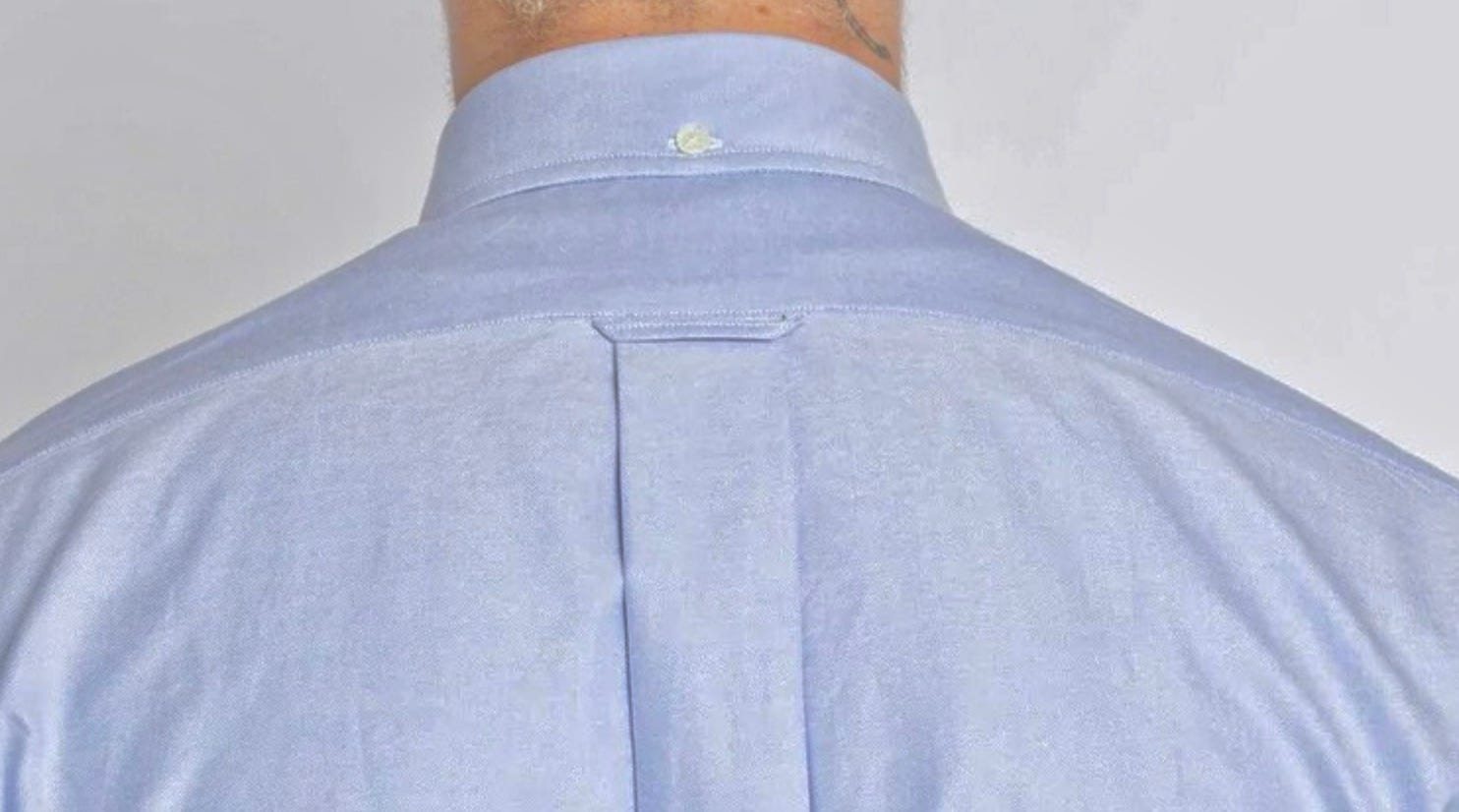
It’s not clear to me if the back button was included as part of Gant’s 1949 launch, or if the button debuted a bit later. It’s also not clear how quickly other brands started following Gant’s back-button lead, or if the back button was ever more the rule than the exception on button-down collars throughout the shirt industry. But based on anecdotal research and my own experiences with vintage clothing, I think it’s fair to say that the back button was fairly common — or at least not uncommon — from the mid-1950s through the mid-1960s.
Another unanswered question is exactly when or why the back button began falling out of favor. A hint comes from a North Carolina newspaper called The Gastonia Gazette, which reported on Nov. 7, 1965, that Gant had just announced its intention to eliminate the back button (and also the locker loop) from its upcoming product. Here are some key passages:
For the past decade, a rear collar button and a hanger loop have become standard equipment on shirts styled in the traditional pattern. They have become accepted, taken for granted, and ignored.
But now comes along one of the major traditional shirt houses in the nation and says buttons and loops will cease to be on their future models.
[…]
Gant shirtmakers, the best-known traditional shirtmaker in America, touched off the wave of restlessness. In the Carolinas, often called the Island of Natural Shoulder History, removal of both the button and loop wouldn’t cause a ripple. For, as some store men say, nobody is looking for either one any more.
Samplings around the two states of stores reveal that a general feeling of “not important” is being attached to both horns of the dilemma.
Tommy Frederick, furnishings manager at Matthews-Belk Co., who cut his teeth on Ivy League clothes, opines: “I don’t think the removal of either or both will make or break a sale. If the shirt has color, fabric, name, and quality, it will sell.”
This feeling was reflected in areas from Raleigh, a hotbed of traditionalism, to Charleston, S.C. The consensus of opinion was that both were first introduced as fads and this has since run its course.
But did Gant actually follow through on that 1965 plan? I looked on eBay and found several vintage Gant magazine ads, all with 1967 copyrights, that clearly show the back button.
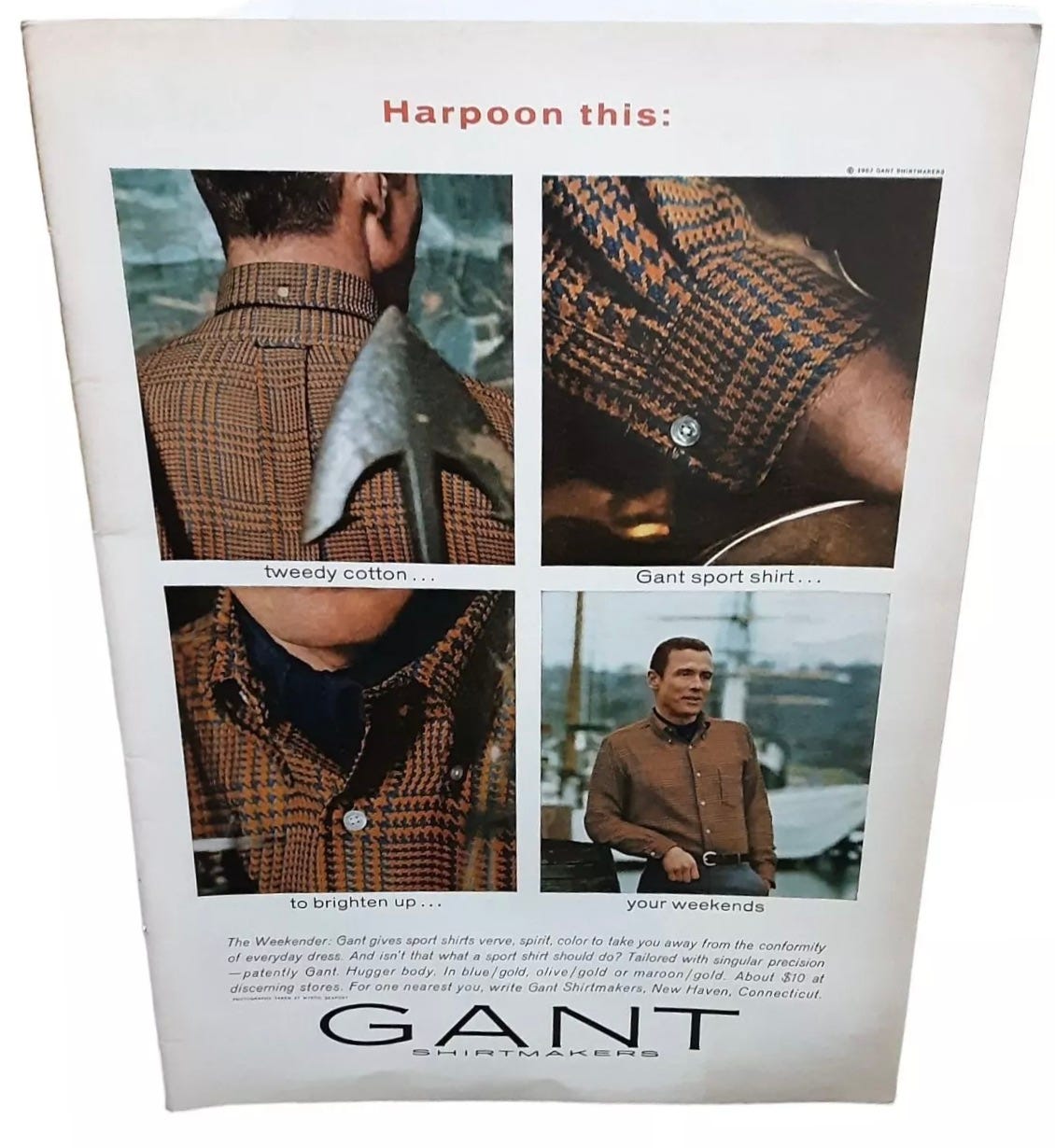
So it appears that Gant ended up keeping the back button at least through 1967. But another major shirt brand apparently did abandon the back button around that same time. That’s according to the preppy-themed blog Ivy Style, which reported in 2011 that Brooks Brothers had just resurrected the back button on some of its shirts after a long absence. The post includes the following passage:
When Brooks Brothers eliminated the third button from its shirts in the late ’60s […] old-school customers were furious and started stockpiling the last remaining third-button shirts, according to a Brooks spokesman.
Aside from the historical timeline, there’s a bigger question to ponder: What exactly is the point of the back button? Some sources, including the Gant website and that Ivy Style blog post I just linked to, say that the button was designed to keep your necktie in place in the back, so the edge of the tie wouldn’t slip down and peek out beneath rear collar.
But even if that was the original idea, it didn’t last for long, because so many shirts with back buttons (including the ones I own) are informal and/or short-sleeved sport shirts that would never be worn with a necktie. In fact, as you may have noticed, the 1967 Gant ad campaign that I just referenced consistently shows the back button on shirts being worn without a tie, thereby rendering the supposed tie-related functionality moot.
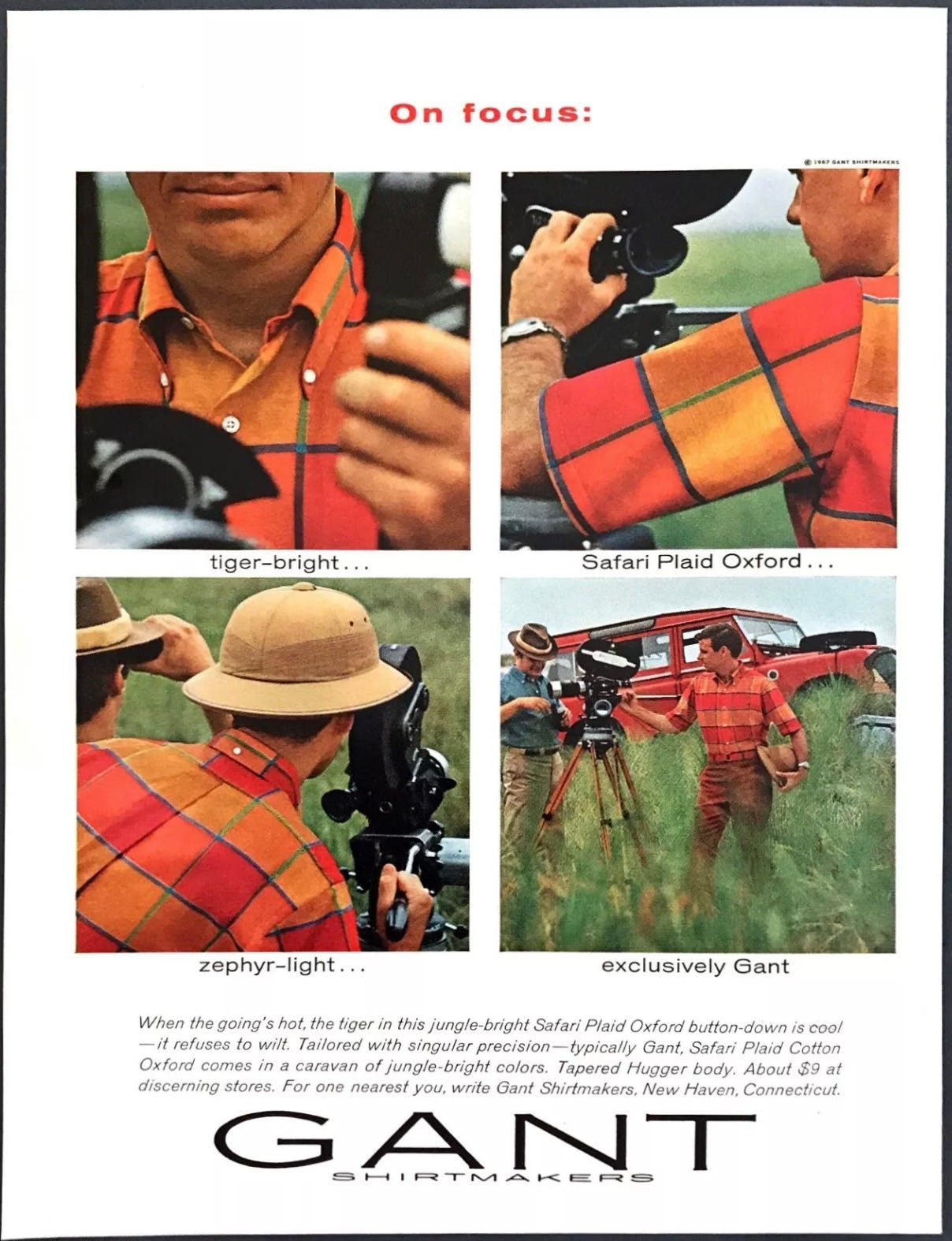
But if the back button isn’t keeping a tie in place, does it serve any other purpose? Several online sources say it can keep the collar from riding up. Frankly, I was dubious, because I’ve never viewed collar creep as much of a problem. But the other day I was reading a recent issue of The New Yorker and, as if on cue, came across a very interesting photo. Look at the two guys in the foreground:
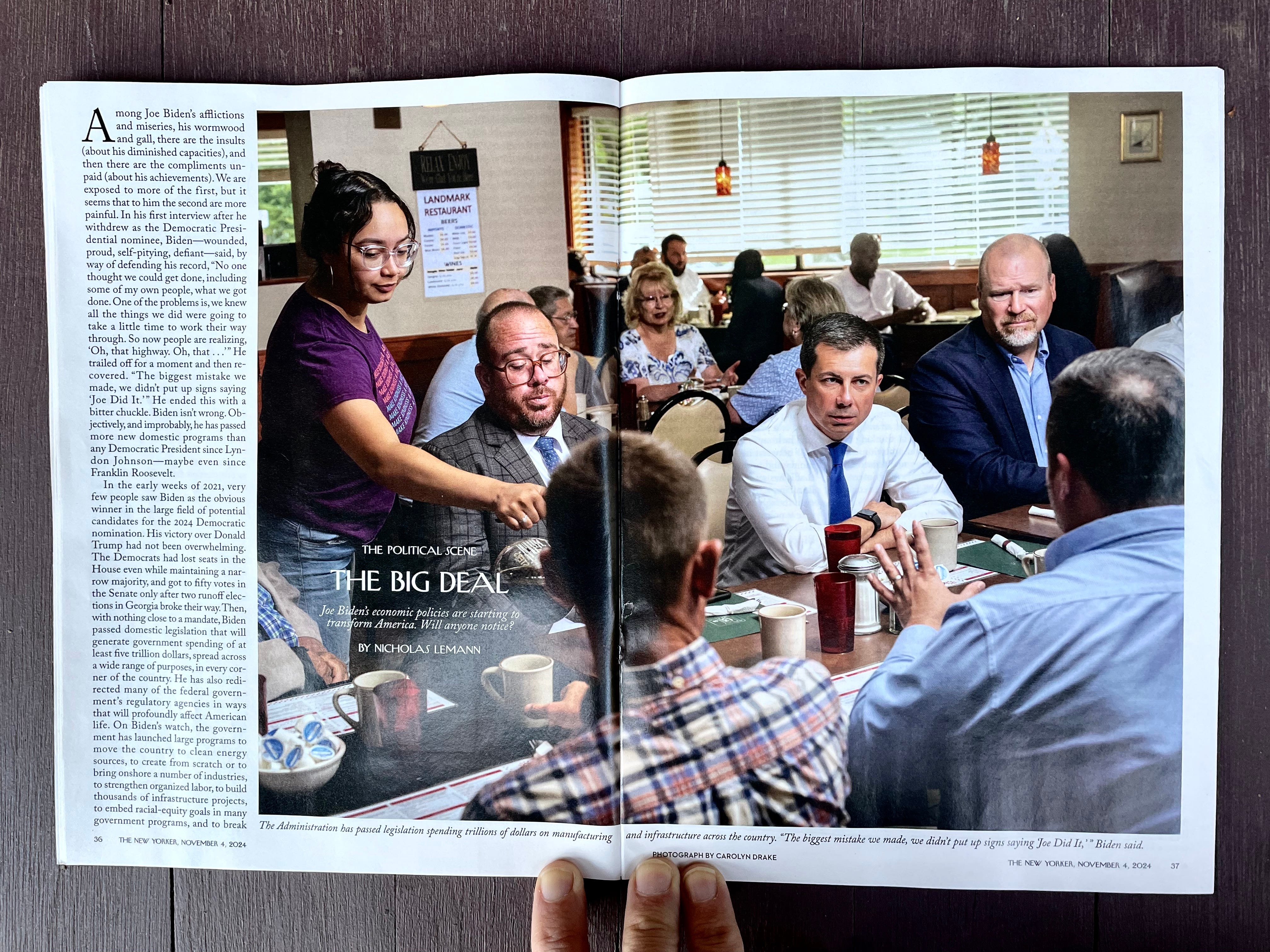
The gentleman on the left, in the plaid shirt, has a back collar button. The fellow sitting next to him, in the blue shirt, doesn’t have a back button — and his collar is riding up. Okay, I’m convinced! (True story: I encountered that photo while reading The New Yorker on the subway, on my way to interview someone for this article. The inconspicu-verse moves in mysterious ways!)
Still, it seems to me that the back button, whatever its initial real or imagined practical utility, soon transcended the functional realm and became more of a stylistic signifier. Over the past few decades, various shirtmakers have periodically revived it as a throwback nod to old-school Ivy League aesthetics, but it’s never caught on as a widespread thing and has thus stubbornly remained inconspicuous.
If you’re looking for a shirt with a back collar button, your best bet in recent years has been to comb through a vintage shop or thrift store (that’s how I got all nine of my back-button shirts). But if you’d rather buy something new, I was surprised to see that a fair number of brands are currently offering the back button, although some of them are pricey:
Gant — which still exists today, although the brand is now owned by a Swedish sportswear company — currently has the back button on its Oxford shirts ($140).
The menswear brand Todd Snyder’s Oxford shirts also have the back button ($148). A recent Wirecutter review of these shirts said that the button is “to keep the neckband flat,” although it’s not clear what that actually means.
J.Crew’s “Giant-Fit” Oxfords currently have the back button ($48.50-$88).
The back button can also be found on Lands’ End’s “Sail Rigger” Oxfords ($60).
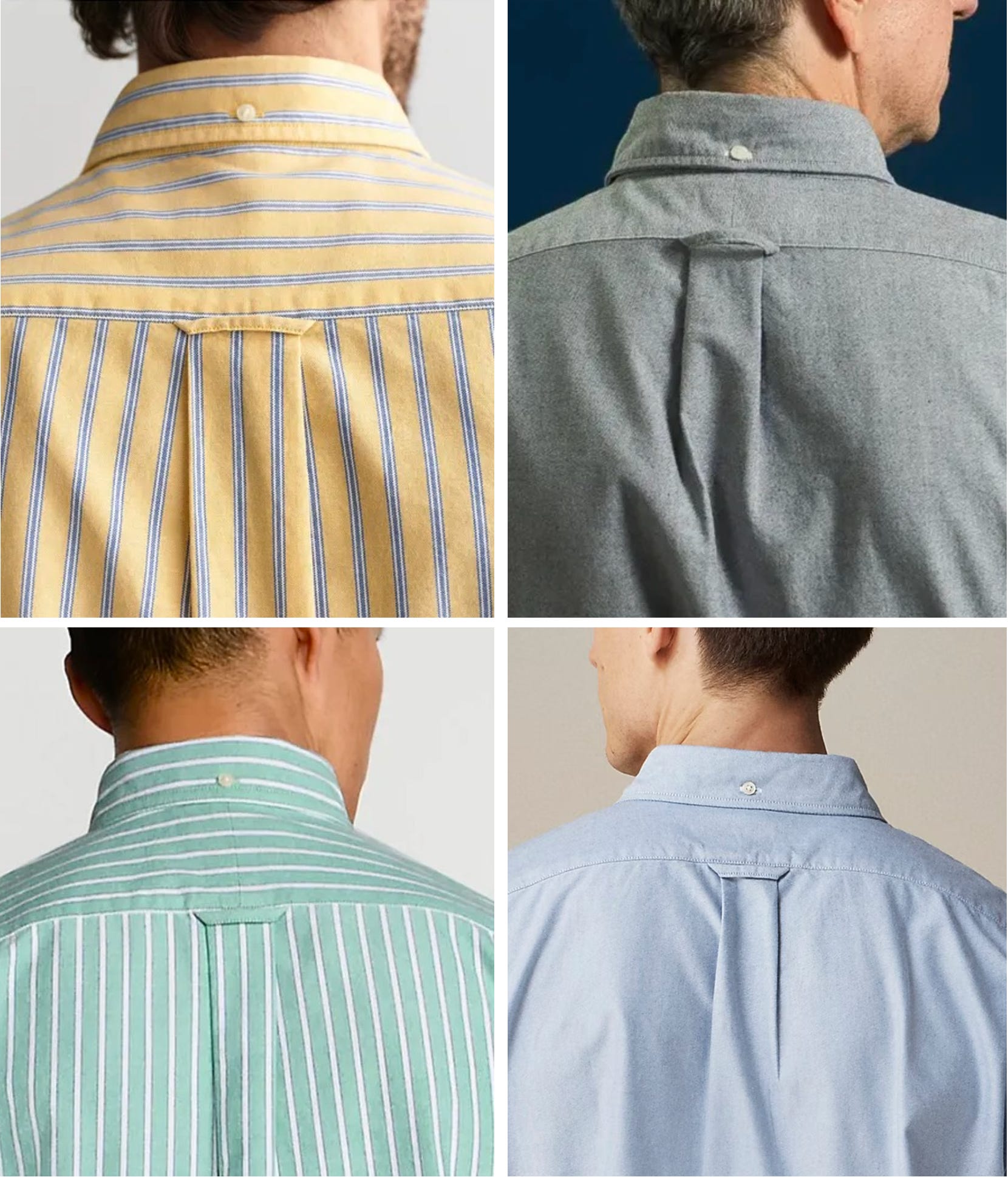
If you’re seeking a back collar button in a non-Oxford fabric, the British clothier New & Lingwood has a Manhattan shop that’s currently stocking linen shirts with a back button ($225).
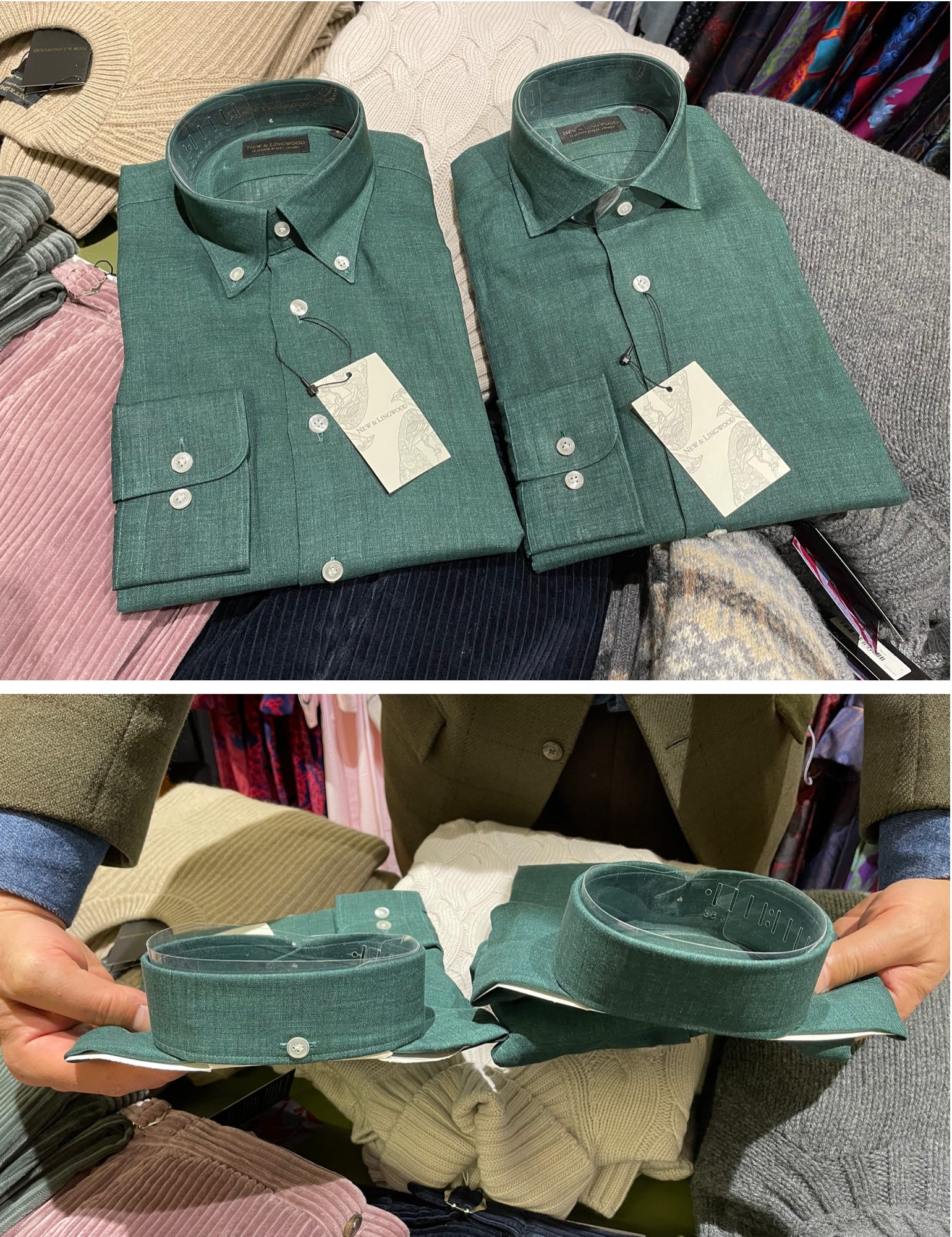
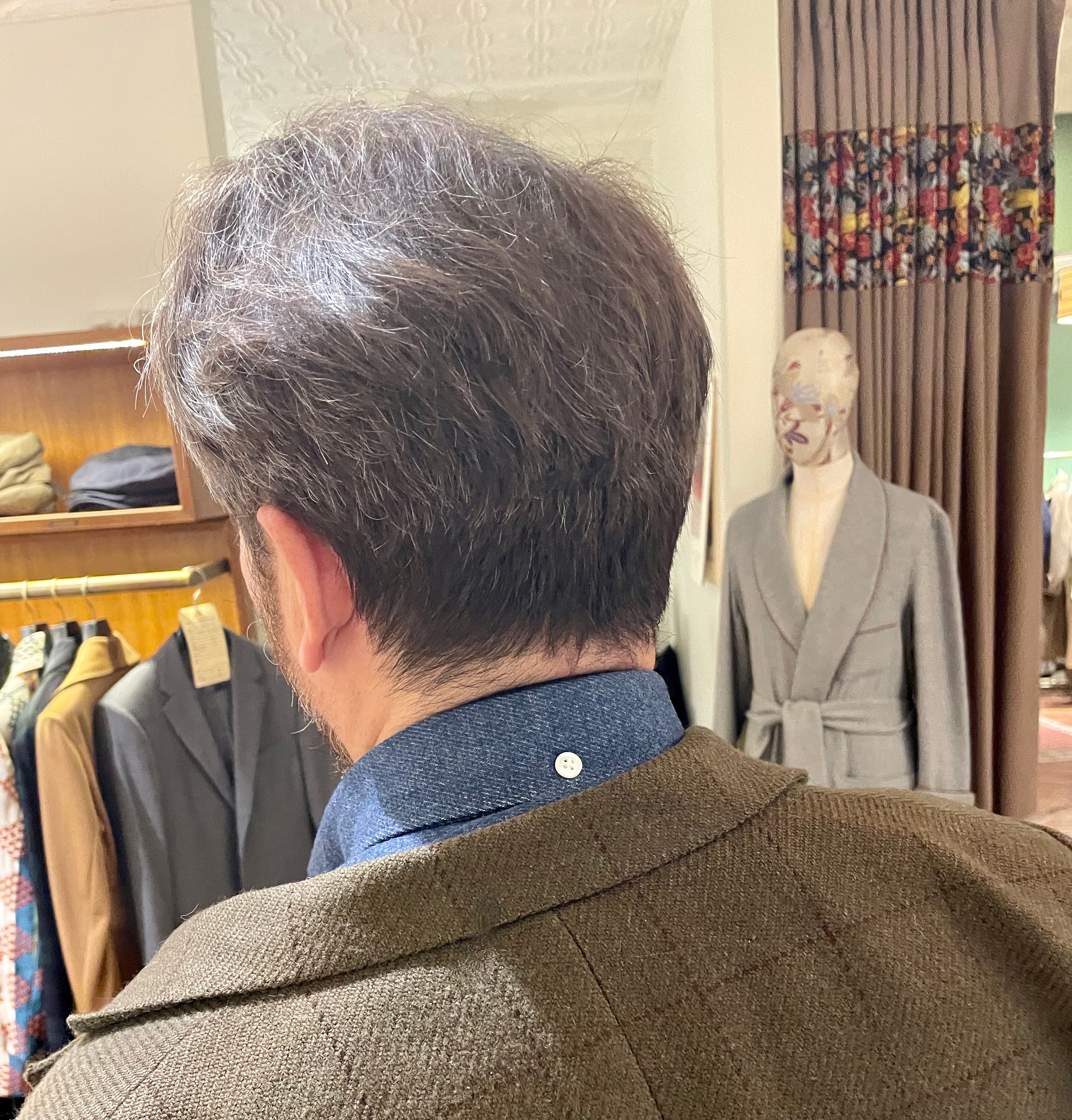
New & Lingwood is a venerable, high-end clothing label that’s been around since 1865 — precisely the kind of brand whose customers might appreciate little nuances like a back collar button. But when I recently visited New & Lingwood’s Manhattan shop to interview its manager, Andrew Yamato, he told me he couldn’t remember any instances of a customer coming in and specifically requesting a shirt equipped with the back button, nor did he think the button’s presence did much to either encourage or discourage sales. In short, he thinks most of his customers don’t really care about or even notice the button.
As if to reinforce that point, when I asked Yamato if the shirt he was wearing during our interview had a back button, he initially said no — and then realized that it actually had the button after all. (Interestingly, the online listing for the New & Lingwood shirt he was wearing doesn’t mention or show the back button, even though the button is part of the shirt design.)
Another way to get yourself a back collar button is to go to a custom shirtmaker like Gambert Shirts, which has been making custom apparel in Newark, N.J., since 1933. They offer the back button as an optional feature, and I was amused to see that their website refers to it as an “executive button” — an entertaining bit of aspirational marketing.
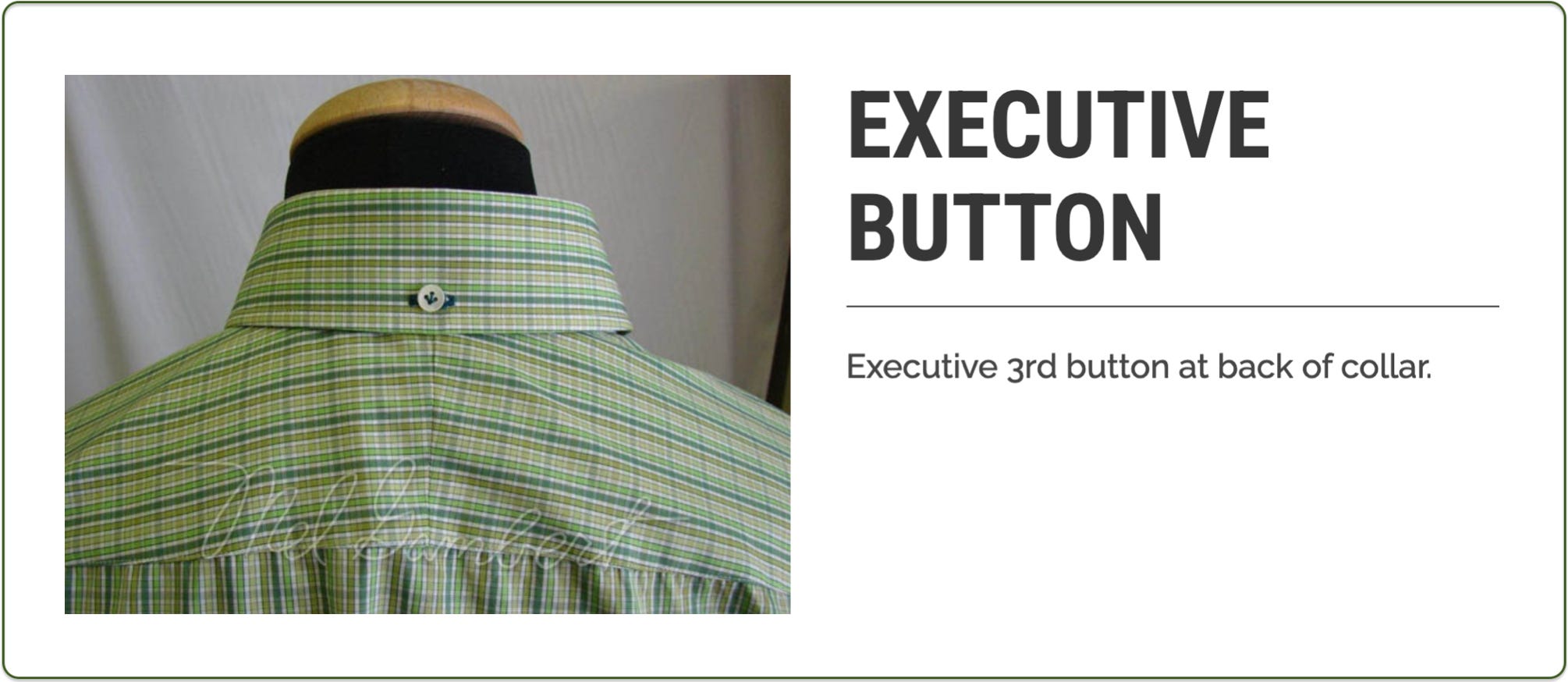
Mitch Gambert, grandson of company founder Joseph Gambert, told me that the “executive” term was coined by his father, Mel Gambert. “My father just comes up with these random quotes once in a while. My wife calls them Mel-isms,” he said. “So at some point he called it the ‘executive button,’ and we’ve stuck with that.”
By any name, the back button isn’t a big seller among Gambert’s clients. “If we make 70,000 shirts a year, I’d be surprised if we make 1,000 with the third button,” he said. “But some people really like it. We work with the Andover Shop up in Massachusetts — they do a lot of that executive button-down. Their customers love that.”
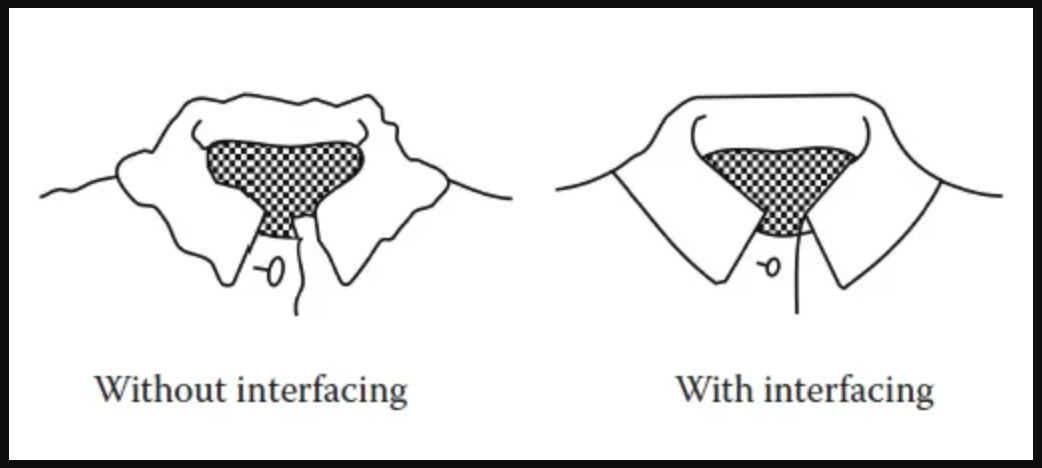
Gambert also provided another possible reason for why the back button came into existence — one that I hadn’t heard or read about anywhere else. He said that the button was particularly useful when used with cheaper, flimsier collars that didn’t have interfacing, because those collars had less body and were prone to bunching up.
“Most collars have that interfacing, which is what gives the collar its stance,” Gambert said. “If you don’t have that, the collar doesn’t hold its shape. So the third button can help with that.”
I’ve presented a lot of information here, but I feel like some key parts of the back button’s story are still waiting to be told. I was hoping to learn more by interviewing some additional industry folks, but PR reps from Brooks Brothers, Gant, J.Crew, Lands’ End, Ralph Lauren, and Todd Snyder all either declined or ignored my entreaties, as if they couldn’t be bothered to discuss such a trifling detail. Sigh — such is the lot of the inconspicuous.
But I did speak to someone who grew up wearing the back collar button. This past weekend, my friend Carrie Klein and I went down to Virginia’s Eastern Shore to visit her father, Victor Klein. Victor was born in 1941, so he went to high school during the late 1950s — prime back-button years.
“Oh sure, everyone had that button,” Victor told me when I asked him about it. “It was viewed as the mark of a good shirt.”
Victor was also able to semi-confirm an intriguing anecdote that turned up in my research. Remember the 1965 article about Gant announcing the removal of the back button (even though they apparently kept the button until at least 1967)? That article included the following passage:
The only objections to removal [of the back collar button] came from the high school set that goes steady. It seems that a boy wearing a shirt unbuttoned at the back is going steady. That means hands off.
Ha! I’d never heard that before, nor could I find any other published references to it, so I asked Victor about it. He said it definitely sounded familiar, although he wasn’t 100% certain about the specifics. (There are also several published accounts of a similar dating protocol regarding locker loops: A male student who was going steady would supposedly remove the loop from his shirt. Victor said he’d never heard about that one. In addition, locker loops became objects of derision in some circles, dismissed as “fag tags” or “fruit loops.”)
I asked Victor if he currently owned any shirts with the back button. He said, “You know, I’m not sure!” — a sentiment that really really captures the back button’s inconspicuous status. So we went up to his closet, which turned out to be back button bereft — disappointing, but not really surprising.

That’s it for now, but I have a feeling we may be revisiting this topic at some point down the road. If you have any additional insights or info on this underrated shirt element, please feel free to post a comment or email me. Thanks!
Paul Lukas has been obsessing over the inconspicuous for most of his life, and has been writing about those obsessions for more than 30 years. You can contact him here.
In case i haven't said it lately, your ability to write 2500 compelling words about a button makes me insanely jealous.
I own two Ben Sherman “polo” shirts that have back buttons. None of my many other shirts of this type have them. I definitely like the look.